中文版
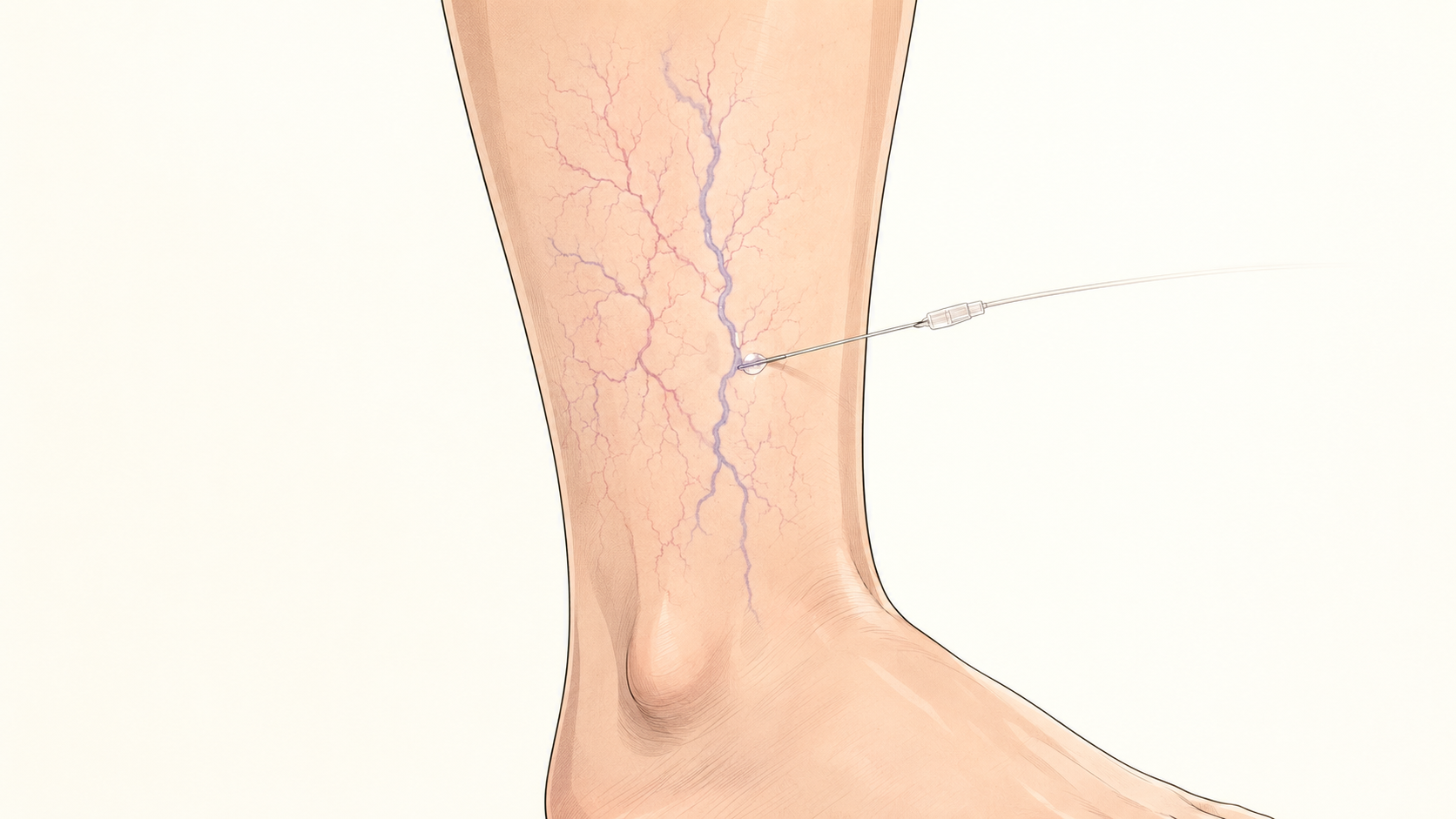
硬化劑注射會使用很細的針,將少量藥物注入目標血管,讓血管逐漸閉合、顏色慢慢淡化。它不是打完立即消失,通常需要幾週至幾個月改善,也可能需要分次治療。
- 指引建議:有症狀的蜘蛛絲血管或網狀血管,可考慮液態或泡沫硬化劑治療。
- 研究結果:硬化劑與雷射都能改善細小腿部血管,但藥物越強不代表一定越好。
- 梁筑鈞醫師的臨床解讀:先看血管走向與供應血管,再用適合濃度、少量、分階段處理。
蜘蛛絲血管、網狀血管與凸起靜脈曲張有什麼不同?
- 蜘蛛絲血管通常是皮膚表面細小的紅色或紫色線條;網狀血管通常稍粗、顏色偏藍綠;凸起靜脈曲張則較粗、彎曲,可能突出皮膚表面。
- 外觀可以幫助描述血管類型,卻不能單靠肉眼確認血液逆流從哪裡開始,也不能單獨決定是否需要治療。
- 評估時仍需結合是否有痠痛、腫脹或皮膚變化、血管分布與臨床檢查;必要時才考慮站立式下肢靜脈超音波。
只有蜘蛛絲血管,需要看醫師嗎?
- 如果只有少量蜘蛛絲血管,沒有痠痛、腫脹、皮膚變化或較粗的靜脈曲張,不代表一定需要治療,也不一定需要例行做完整超音波。
- 若在意外觀、血管範圍增加,或同時有腿部症狀、單側腫脹、皮膚變化、較粗的曲張血管或其他疑慮,可以安排臨床評估。
- 是否觀察、進一步檢查或治療,應依個別臨床情況與需求決定。
不是看到一條,就打一條
- 蜘蛛絲血管下方,有時連接較深、稍粗的網狀血管。若只處理表面,卻沒有找出供應血管,效果可能不完整,也比較容易再次出現。
- 治療前我會先看血管的顏色、粗細、深度與分布,再決定注射順序、藥物濃度及每次處理範圍。
- 重點不是注射得多,而是用適合的方式,從較粗的血管逐步處理到細小血管。
注射後可能有哪些反應?
- 常見反應包括瘀青、局部疼痛、暫時性色素沉澱,以及治療區出現更細的新生血管。
- 少數情況可能發生皮膚傷口、血栓或過敏反應。
- 2023年的系統性回顧顯示,硬化劑及雷射都可以改善腿部細小血管,但藥物越強不代表一定越好,較強的硬化劑也可能增加色素沉澱等副作用。
需要治療幾次?
- 蜘蛛絲血管通常需要耐心、分階段治療,治療次數會受到血管數量、粗細、深度與皮膚反應影響。
- 每次治療後要等血管逐漸淡化,再評估下一階段;即使治療完成,未來仍可能長出新的細小血管。
硬化劑注射前,先看這四件事
| 評估重點 | 為什麼重要 | 常見做法 |
|---|---|---|
| 血管粗細與深度 | 影響藥物濃度與注射順序 | 由較粗供應血管逐步處理 |
| 是否有腿痠、腫脹 | 可能代表不只是外觀問題 | 必要時安排超音波 |
| 治療後皮膚反應 | 瘀青與色素沉澱需要時間改善 | 分階段觀察 |
| 治療期待 | 蜘蛛絲血管不是一次全部消失 | 先說明次數與恢復時間 |
常見問題
蜘蛛絲血管就是凸起的靜脈曲張嗎?
不是。蜘蛛絲血管是皮膚表面細小的紅紫色血管;凸起靜脈曲張通常較粗、彎曲。外觀只能描述看得到的血管,不能單獨確認逆流來源。
只有少量蜘蛛絲血管,一定要做站立式超音波嗎?
不一定。若沒有症狀、腫脹、皮膚變化或較粗的曲張血管,未必需要例行完整檢查;是否安排超音波仍由臨床情況決定。
蜘蛛絲血管可以直接接受硬化劑治療嗎?
需先確認血管類型、分布、相關症狀與治療目標。對適合的局部血管可考慮硬化劑治療,但不是每一條看得到的血管都適合直接注射。
提醒:如果蜘蛛絲血管合併單側突然腫痛、皮膚發熱或呼吸困難,請儘速就醫。這些情況不適合只當作外觀問題處理。
English
Sclerotherapy uses a very fine needle to deliver a small amount of medication into the target vein. The treated vessel gradually closes and fades. The vein does not disappear immediately; improvement usually develops over several weeks or months, and more than one treatment session may be needed.
- Guideline recommendation: Liquid or foam sclerotherapy may be considered for symptomatic spider veins or reticular veins.
- Research finding: Both sclerotherapy and laser treatment can improve small leg veins, but a stronger medication is not automatically better.
- Dr LiangVascular’s clinical interpretation: Assess the vessel pattern and feeding veins first, then use an appropriate concentration, small amounts and a staged approach.
How do spider veins, reticular veins and bulging varicose veins differ?
- Spider veins usually appear as fine red or purple lines near the skin surface. Reticular veins are generally slightly larger and blue-green, while bulging varicose veins are larger, twisted vessels that may project above the skin.
- Appearance helps describe the type of visible vessel, but it cannot show where reflux begins or determine by itself whether treatment is needed.
- Assessment still considers symptoms, swelling or skin change, vessel distribution and clinical examination. Standing leg-vein ultrasound is considered only when clinically appropriate.
Do spider veins alone need medical assessment?
- A small number of spider veins without aching, swelling, skin change or larger varicose veins does not automatically require treatment or a routine full duplex scan.
- Assessment may be helpful when appearance is a concern, the vessel pattern is increasing, or there are associated symptoms, one-sided swelling, skin changes, larger varicose veins or broader clinical concerns.
- Observation, further investigation and treatment should be selected according to the individual clinical context and the patient's goals.
Treatment is not simply injecting every visible vein
- Spider veins may be connected to slightly larger feeding veins beneath the skin. Treating only the visible surface vessels without identifying these connections may produce an incomplete result or allow the veins to reappear sooner.
- Before treatment, I assess the colour, size, depth and pattern of the vessels. These findings help determine the injection order, medication concentration and area treated during each session.
- The goal is not to perform as many injections as possible. It is to use an appropriate technique and work gradually from the larger feeding vessels towards the finer spider veins.
What reactions can occur after treatment?
- Common reactions include bruising, local tenderness, temporary pigmentation and the appearance of very fine new vessels around the treated area.
- Less common complications include skin injury, thrombosis and allergic reactions.
- A 2023 systematic review found that both sclerotherapy and laser treatments can improve small leg veins. However, a stronger sclerosant is not automatically better, because increasing potency may also increase unwanted effects such as pigmentation.
How many sessions are needed?
- Spider veins often require patience and staged treatment. The number of sessions depends on the number, size and depth of the vessels, as well as the skin response.
- After each treatment, the vessels need time to fade before the next stage is assessed. Even after successful treatment, new small vessels may still develop in the future.
Four things to assess before sclerotherapy
| Assessment | Why it matters | Common approach |
|---|---|---|
| Vessel size and depth | Affects medication concentration and injection order | Work gradually from larger feeding veins |
| Aching or swelling | May indicate more than a cosmetic concern | Arrange an ultrasound when appropriate |
| Skin response | Bruising and pigmentation need time to improve | Observe between stages |
| Treatment expectations | Spider veins do not all disappear after one session | Discuss likely sessions and recovery time |
Frequently asked questions
Are spider veins the same as bulging varicose veins?
No. Spider veins are fine red or purple surface vessels, while bulging varicose veins are generally larger and twisted. Appearance alone cannot identify the source of reflux.
Do a few spider veins always require standing duplex ultrasound?
No. A routine full scan may not be necessary when there are no symptoms, swelling, skin changes or larger varicose veins. The decision remains clinical.
Can spider veins be treated directly with sclerotherapy?
The vessel type, distribution, associated symptoms and treatment goal should be assessed first. Sclerotherapy may be considered for selected local vessels, but not every visible vein should be injected automatically.
Note: Sudden one-sided swelling, warmth, significant pain or shortness of breath requires prompt medical attention. These symptoms should not be treated as a cosmetic concern alone.
References
- Gloviczki P, Lawrence PF, Wasan SM, et al. The 2023 Society for Vascular Surgery, American Venous Forum, and American Vein and Lymphatic Society Clinical Practice Guidelines for the Management of Varicose Veins of the Lower Extremities. Part II. Journal of Vascular Surgery: Venous and Lymphatic Disorders. 2024;12(1):101670. 查看來源
- De Maeseneer MG, Kakkos SK, Aherne T, et al. European Society for Vascular Surgery 2022 Clinical Practice Guidelines on the Management of Chronic Venous Disease of the Lower Limbs. European Journal of Vascular and Endovascular Surgery. 2022;63(2):184–267. 查看來源
- Bontinis V, Bontinis A, Koutsoumpelis A, et al. Interventions for the Treatment of Lower Limb Telangiectasias and Reticular Veins: A Systematic Review and Network Meta-Analysis. European Journal of Vascular and Endovascular Surgery. 2023;66(4):560–576. 查看來源
- Tan M, Shaydakov E, Parsi K, Davies AH; International Union of Phlebology. Microsclerotherapy. Phlebology. 2024;39(4):280–283. 查看來源
本文提供一般衛教,不取代個別診斷或治療。若有急性不舒服,請先就近就醫。
Dr LiangVascular
從完整評估開始
先整合症狀、理學檢查與超音波結果,再討論適合的治療選擇。
預約門診