Clinical Education
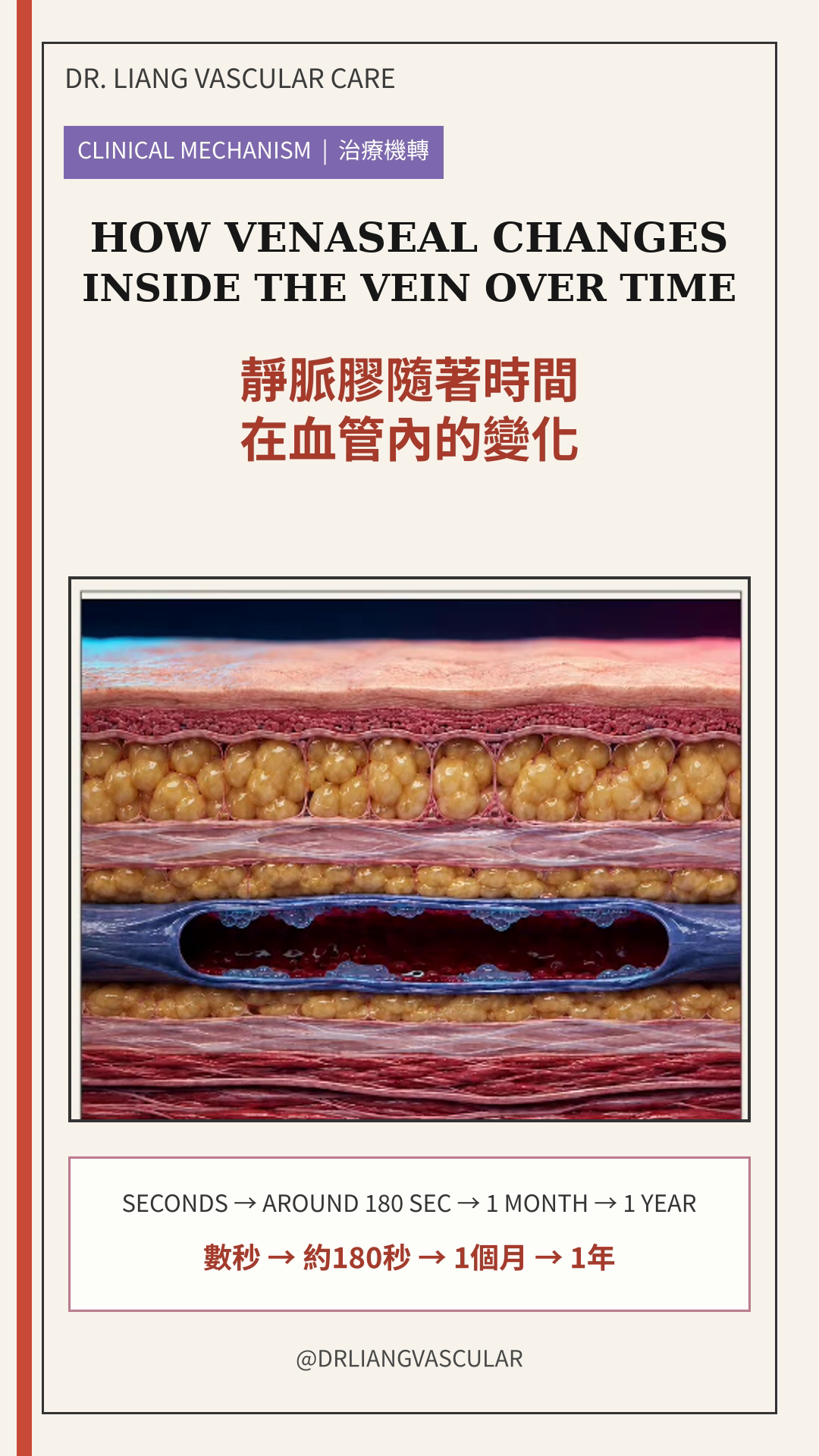
Closure is only the first step. The body develops a local healing and foreign-body response around the implant, followed by fibrosis and longer-term remodelling of the treated vein.
- The adhesive polymerizes rapidly inside the vein; closure does not depend on external stocking pressure
- VenaSeal is nonthermal and does not require tumescent injections along the treated vein
- It is a permanent implant; long-term tissue specimens can still show polymer remnants enclosed by fibrous tissue
Within seconds: polymerization begins
- The medical cyanoacrylate rapidly polymerizes after contact with blood and the intravascular environment.
- Ultrasound localization and brief external pressure help coapt the walls of the target vein.
- This is direct internal adhesive closure—not closure maintained by a stocking squeezing the entire vein from outside.
Within minutes: stable wall coaptation
- The video's 'around 180 seconds' is an educational illustration of polymerization and wall coaptation, not a universal human histology timestamp.
- Adhesive is delivered segment by segment along the planned truncal vein.
- Blood is redirected through functioning deep and superficial veins.
Weeks to months: healing and fibrosis
- Animal histology demonstrates local inflammation, foreign-body giant-cell reaction and progressive fibrosis in the closed vein.
- Some patients develop redness, warmth, itching, tenderness or pulling; clinical assessment distinguishes expected healing from phlebitis or hypersensitivity.
- Worsening or spreading symptoms and marked one-sided swelling warrant earlier review.
Long term: remodelling with persistent implant material
- Long-term human histology has shown mature collagenized fibrous tissue with polymer remnants enclosed by fibrous tissue and multinucleated giant cells.
- VenaSeal should therefore be understood as a permanent implant, not a drug that is completely absorbed soon after treatment.
- The degree and speed of vein shrinkage vary and should be interpreted together with symptoms and ultrasound follow-up.
Why are stockings usually unnecessary after isolated VenaSeal treatment?
- The closure mechanism is different: polymerized adhesive directly coapts the vein walls, so successful closure does not depend on continued external compression.
- The procedure is nonthermal, avoids thermal injury and does not require multiple tumescent injections along the vein; thermal-ablation compression routines therefore do not automatically apply.
- The prospective WAVES study reported early truncal closure without postprocedure stockings and without concomitant side-branch treatment, supporting a no-routine-compression approach after isolated VenaSeal treatment.
- Usually unnecessary does not mean never useful. Compression may still be advised after simultaneous phlebectomy or sclerotherapy, or for marked bruising, swelling, venous ulceration or another individual indication. Follow the treating clinician's instructions.
Changes after VenaSeal and the role of compression
| Stage | Inside the vein | Role of stockings |
|---|---|---|
| Seconds to minutes | Polymerization and wall coaptation | Closure does not depend on external pressure |
| Weeks to months | Healing, foreign-body response and fibrosis | Usually unnecessary after isolated truncal treatment |
| Additional tributary treatment | More bruising, swelling or tenderness may occur | May be prescribed according to treatment extent |
| Long term | Fibrous enclosure of polymer and vein remodelling | Cannot guarantee freedom from recurrence or new veins |
Frequently asked questions
Does this mean stockings must never be worn after VenaSeal?
No. Depending on the individual case and treatment, compression stockings may not be required after VenaSeal. If recommended, they are usually worn for up to 1 week.
Will the vein reopen if I do not wear stockings?
VenaSeal closure is created by polymerization and direct wall coaptation inside the vein, not by stockings. Long-term closure still depends on anatomy, treatment positioning and individual response, so ultrasound follow-up remains important.
Is the adhesive completely absorbed?
Long-term human histology has found polymer remnants enclosed by mature fibrous tissue. VenaSeal should be considered a permanent implant rather than a rapidly absorbable medication.
Are redness, warmth, itching or pain normal?
A local inflammatory or foreign-body response may occur, but severity, extent and duration matter. Worsening or spreading symptoms, marked one-sided swelling, chest pain or shortness of breath require urgent assessment.
Note: Seek urgent medical assessment for sudden marked one-sided swelling, worsening pain, a widespread rash, chest pain, shortness of breath or other acute symptoms after VenaSeal treatment.
References
- Medtronic. VenaSeal Closure System: healthcare professional information, indications, warnings and post-procedure compression guidance. View source
- Gibson K, et al. Cyanoacrylate closure of incompetent great, small and accessory saphenous veins without the use of post-procedure compression: initial outcomes of the WAVES Study. Vascular. 2017;25(2):149–156. View source
- Gibson K, Ferris B. Cyanoacrylate closure of incompetent great, small and accessory saphenous veins without the use of post-procedure compression: 3-month outcomes of the WAVES Study. Phlebology. 2017;32(10):708–713. PMID: 30227791. View source
- Almeida JI, et al. Cyanoacrylate adhesive for the closure of truncal veins: 60-day swine model results. Vasc Endovascular Surg. 2011;45(7):631–635. DOI: 10.1177/1538574411413938. View source
- Kolluri R, et al. VenaSeal glue foreign body reaction in the human great saphenous vein: histopathologic findings at 5.5 years. J Vasc Surg Venous Lymphat Disord. 2020;8(2):280–284. DOI: 10.1016/j.jvsv.2019.04.014. View source
This article and animation provide general health education. The timeline summarizes the treatment mechanism and limited histological evidence; changes do not occur at identical times in every patient. 'No routine stockings after isolated VenaSeal' does not apply to every additional procedure or clinical situation. Follow your treating clinician's instructions.
Dr LiangVascular
Begin with a careful assessment.
Symptoms, examination and ultrasound findings are considered before treatment options are discussed.
Book an Appointment