中文版
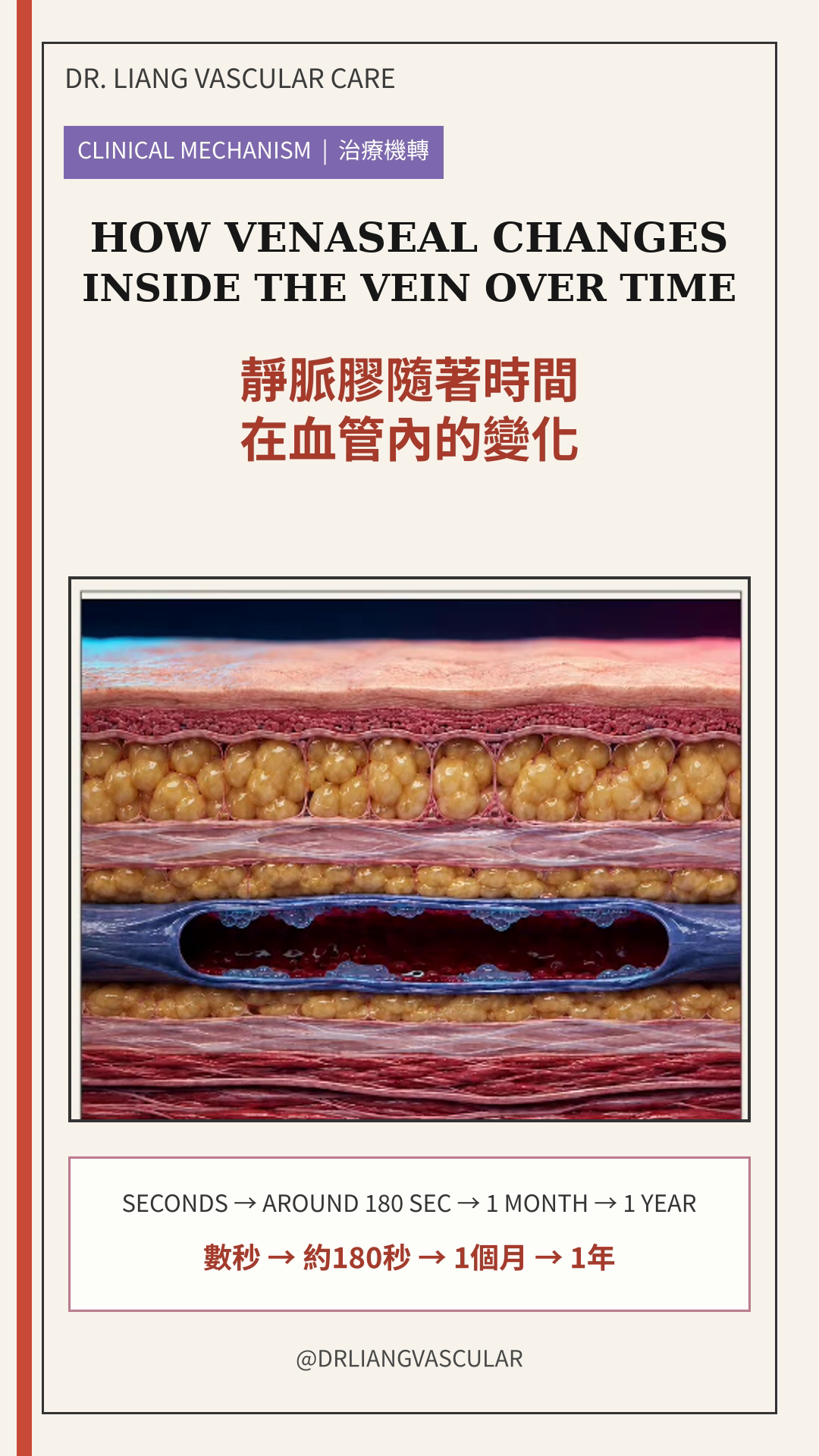
閉合只是第一步。接下來,身體會對植入的醫療膠產生局部修復與異物反應,逐步形成纖維化組織,讓原本有逆流的血管長期維持閉合並慢慢重塑。
- 靜脈膠在血管內快速聚合;不是靠彈性襪從外面壓住才會閉合
- VenaSeal是非熱治療,不需要沿整段血管注射腫脹麻醉液
- 醫療膠是永久性植入物,長期組織檢體仍可見被纖維組織包覆的聚合物殘留
數秒內:靜脈膠開始聚合
- 醫療膠接觸血液與血管內環境後會快速聚合,從液態轉為固態聚合物。
- 醫師以超音波定位並在血管外適度加壓,使目標靜脈的兩側血管壁貼合。
- 這是醫療膠直接造成的內部閉合,不等同於用彈性襪把整條血管從外面壓扁。
約數分鐘:形成穩定貼合
- 動畫中的『約180秒』用來呈現聚合與血管壁貼合的治療機轉,不是所有人體組織都在同一秒完成相同變化。
- 治療過程會沿目標血管分段送膠並加壓,讓已規劃的靜脈主幹逐段閉合。
- 腿部血液之後會改由功能正常的深層與其他表淺靜脈回流。
數週至數月:修復反應與纖維化
- 動物組織研究顯示,閉合血管會經歷局部發炎、異物巨細胞反應與纖維化。
- 部分病人術後可能沿治療血管出現紅、熱、癢、壓痛或拉扯感;這些症狀仍需由醫師判斷是一般修復反應、靜脈炎或過敏反應。
- 症狀加劇、範圍擴大或合併明顯單側腫脹時,應提早回診。
長期:血管重塑,但醫療膠不會立刻消失
- 長期人體病理檢體顯示,治療血管可形成成熟的膠原纖維組織,聚合物殘留被纖維組織與多核巨細胞包覆。
- 因此,應把VenaSeal理解為永久性植入的醫療膠,而不是短時間內完全被人體吸收的藥物。
- 血管縮小與組織重塑的速度因人而異,仍需依症狀與超音波追蹤判斷。
為什麼單純VenaSeal術後多數情況不用例行穿彈性襪?
- 第一個原因是閉合機轉不同:VenaSeal靠血管內的醫療膠快速聚合並讓血管壁直接貼合,療效不依賴術後從外部持續加壓。
- 第二個原因是它屬於非熱治療,不需要沿整段血管施打腫脹麻醉,也沒有雷射或射頻造成的熱損傷;因此術後照護不必沿用熱消融的同一套壓迫流程。
- WAVES前瞻性研究在沒有術後彈性襪、也沒有同時治療分支血管的情況下,仍觀察到良好的早期主幹閉合,支持單純VenaSeal主幹治療不需依賴彈性襪。
- 但『通常不需例行穿著』不等於『任何情況都不能穿』。若同時做凸起分支的微創摘除、硬化劑治療,或病人有明顯瘀青、腫脹、靜脈潰瘍或其他需要,醫師仍可能建議短期穿著。請以個別術後指示為準。
VenaSeal後的血管變化與彈性襪角色
| 階段 | 血管內的變化 | 彈性襪的角色 |
|---|---|---|
| 數秒至數分鐘 | 醫療膠聚合、血管壁貼合 | 閉合不依賴外部壓迫 |
| 數週至數月 | 局部修復、異物反應與纖維化 | 單純主幹治療通常不需例行穿著 |
| 合併分支治療 | 可能增加局部瘀青、腫脹或疼痛 | 可依處置範圍個別建議 |
| 長期 | 纖維組織包覆聚合物、血管重塑 | 不能保證避免復發或新生靜脈曲張 |
常見問題
VenaSeal後完全不能穿彈性襪嗎?
不是。依個案與治療情況,術後可能不需穿著壓力襪;如需穿著,通常約 0–1 週。請依實際治療醫師的個別術後指示。
不穿彈性襪,血管會不會重新打開?
VenaSeal的閉合來自血管內醫療膠的聚合與血管壁貼合,不是靠彈性襪維持。是否長期閉合仍受血管條件、治療定位與個人反應影響,應依超音波追蹤。
醫療膠會被身體完全吸收嗎?
目前長期人體病理資料顯示,聚合物殘留可被成熟纖維組織包覆,因此VenaSeal應視為永久性植入物,而不是會在短期內完全吸收的藥物。
術後紅、熱、癢或疼痛正常嗎?
局部發炎或異物反應可能出現,但仍要依嚴重程度、範圍與持續時間判斷。若症狀惡化、範圍擴大、出現明顯單側腫脹、胸痛或呼吸困難,請立即就醫。
提醒:VenaSeal後若出現突然單側明顯腫脹、持續加劇的疼痛、廣泛紅疹、胸痛、呼吸困難或其他急性不適,請立即聯絡醫療院所或就近就醫。
English
Closure is only the first step. The body develops a local healing and foreign-body response around the implant, followed by fibrosis and longer-term remodelling of the treated vein.
- The adhesive polymerizes rapidly inside the vein; closure does not depend on external stocking pressure
- VenaSeal is nonthermal and does not require tumescent injections along the treated vein
- It is a permanent implant; long-term tissue specimens can still show polymer remnants enclosed by fibrous tissue
Within seconds: polymerization begins
- The medical cyanoacrylate rapidly polymerizes after contact with blood and the intravascular environment.
- Ultrasound localization and brief external pressure help coapt the walls of the target vein.
- This is direct internal adhesive closure—not closure maintained by a stocking squeezing the entire vein from outside.
Within minutes: stable wall coaptation
- The video's 'around 180 seconds' is an educational illustration of polymerization and wall coaptation, not a universal human histology timestamp.
- Adhesive is delivered segment by segment along the planned truncal vein.
- Blood is redirected through functioning deep and superficial veins.
Weeks to months: healing and fibrosis
- Animal histology demonstrates local inflammation, foreign-body giant-cell reaction and progressive fibrosis in the closed vein.
- Some patients develop redness, warmth, itching, tenderness or pulling; clinical assessment distinguishes expected healing from phlebitis or hypersensitivity.
- Worsening or spreading symptoms and marked one-sided swelling warrant earlier review.
Long term: remodelling with persistent implant material
- Long-term human histology has shown mature collagenized fibrous tissue with polymer remnants enclosed by fibrous tissue and multinucleated giant cells.
- VenaSeal should therefore be understood as a permanent implant, not a drug that is completely absorbed soon after treatment.
- The degree and speed of vein shrinkage vary and should be interpreted together with symptoms and ultrasound follow-up.
Why are stockings usually unnecessary after isolated VenaSeal treatment?
- The closure mechanism is different: polymerized adhesive directly coapts the vein walls, so successful closure does not depend on continued external compression.
- The procedure is nonthermal, avoids thermal injury and does not require multiple tumescent injections along the vein; thermal-ablation compression routines therefore do not automatically apply.
- The prospective WAVES study reported early truncal closure without postprocedure stockings and without concomitant side-branch treatment, supporting a no-routine-compression approach after isolated VenaSeal treatment.
- Usually unnecessary does not mean never useful. Compression may still be advised after simultaneous phlebectomy or sclerotherapy, or for marked bruising, swelling, venous ulceration or another individual indication. Follow the treating clinician's instructions.
Changes after VenaSeal and the role of compression
| Stage | Inside the vein | Role of stockings |
|---|---|---|
| Seconds to minutes | Polymerization and wall coaptation | Closure does not depend on external pressure |
| Weeks to months | Healing, foreign-body response and fibrosis | Usually unnecessary after isolated truncal treatment |
| Additional tributary treatment | More bruising, swelling or tenderness may occur | May be prescribed according to treatment extent |
| Long term | Fibrous enclosure of polymer and vein remodelling | Cannot guarantee freedom from recurrence or new veins |
Frequently asked questions
Does this mean stockings must never be worn after VenaSeal?
No. Depending on the individual case and treatment, compression stockings may not be required after VenaSeal. If recommended, they are usually worn for up to 1 week.
Will the vein reopen if I do not wear stockings?
VenaSeal closure is created by polymerization and direct wall coaptation inside the vein, not by stockings. Long-term closure still depends on anatomy, treatment positioning and individual response, so ultrasound follow-up remains important.
Is the adhesive completely absorbed?
Long-term human histology has found polymer remnants enclosed by mature fibrous tissue. VenaSeal should be considered a permanent implant rather than a rapidly absorbable medication.
Are redness, warmth, itching or pain normal?
A local inflammatory or foreign-body response may occur, but severity, extent and duration matter. Worsening or spreading symptoms, marked one-sided swelling, chest pain or shortness of breath require urgent assessment.
Note: Seek urgent medical assessment for sudden marked one-sided swelling, worsening pain, a widespread rash, chest pain, shortness of breath or other acute symptoms after VenaSeal treatment.
References
- Medtronic. VenaSeal Closure System: healthcare professional information, indications, warnings and post-procedure compression guidance. 查看來源
- Gibson K, et al. Cyanoacrylate closure of incompetent great, small and accessory saphenous veins without the use of post-procedure compression: initial outcomes of the WAVES Study. Vascular. 2017;25(2):149–156. 查看來源
- Gibson K, Ferris B. Cyanoacrylate closure of incompetent great, small and accessory saphenous veins without the use of post-procedure compression: 3-month outcomes of the WAVES Study. Phlebology. 2017;32(10):708–713. PMID: 30227791. 查看來源
- Almeida JI, et al. Cyanoacrylate adhesive for the closure of truncal veins: 60-day swine model results. Vasc Endovascular Surg. 2011;45(7):631–635. DOI: 10.1177/1538574411413938. 查看來源
- Kolluri R, et al. VenaSeal glue foreign body reaction in the human great saphenous vein: histopathologic findings at 5.5 years. J Vasc Surg Venous Lymphat Disord. 2020;8(2):280–284. DOI: 10.1016/j.jvsv.2019.04.014. 查看來源
本文與動畫提供一般衛教。動畫時間軸是治療機轉與有限組織研究的概括,不代表每位病人的變化都發生在完全相同的時間點。『多數單純VenaSeal不需例行穿彈性襪』不適用於所有合併處置或個別病況;請遵循實際治療醫師的術後指示。
Dr LiangVascular
從完整評估開始
先整合症狀、理學檢查與超音波結果,再討論適合的治療選擇。
預約門診