Clinical Education
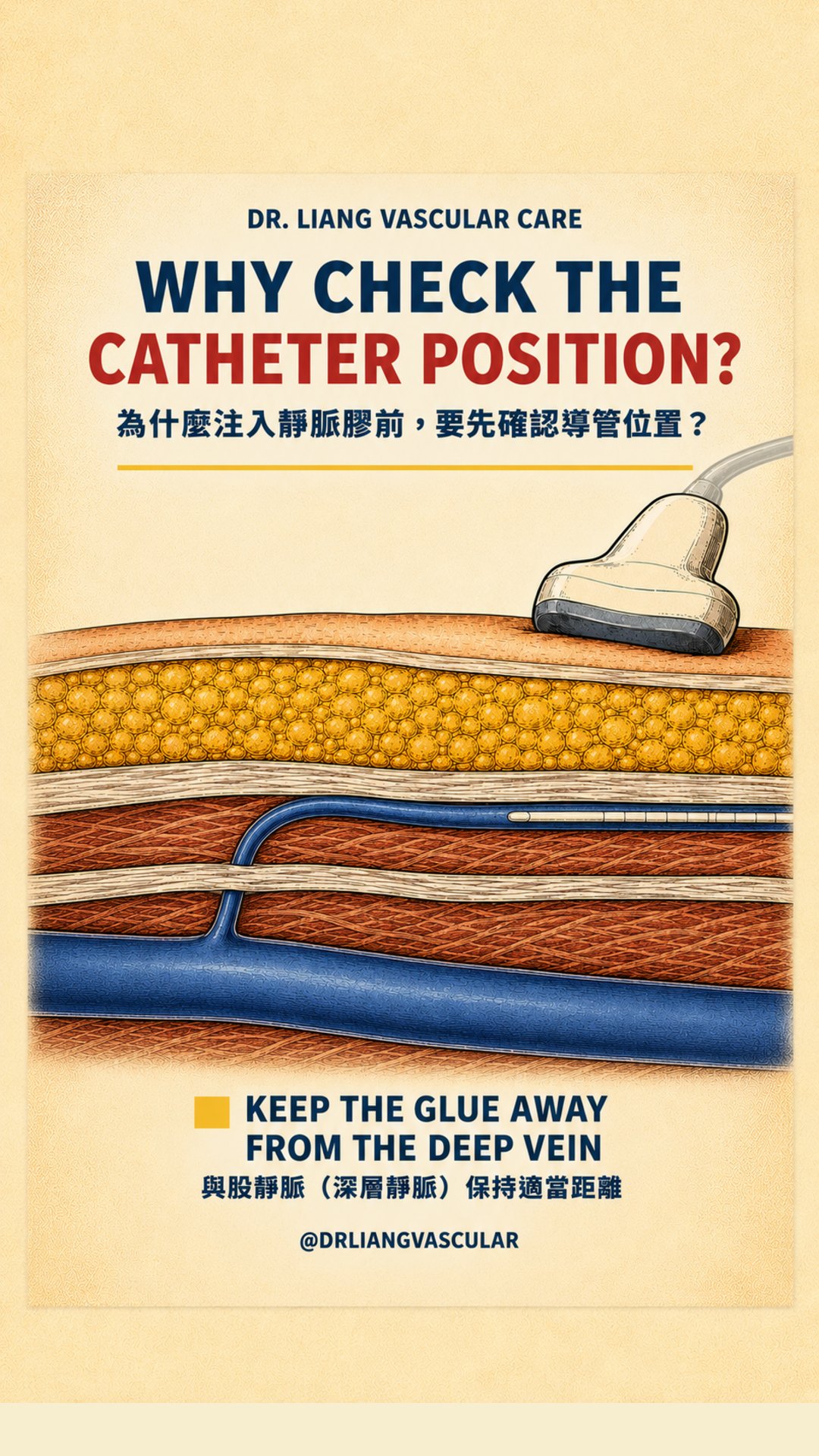
Before the first adhesive delivery, ultrasound confirms that the catheter tip remains within the intended superficial target vein and shows its relationship to the saphenofemoral junction. Under the standard instructions for use, the tip is positioned at least 5 cm distal to the junction before segmental adhesive delivery begins.
- The catheter tip stays in the intended superficial target vein—not the deep vein
- Ultrasound identifies the tip, saphenofemoral junction and deep vein in real time
- Before the first adhesive delivery, the standard protocol confirms at least 5 cm along the vein
Where is the 5 cm measured?
- It is not measured from the skin and is not a perpendicular distance to the femoral vein.
- It is measured along the great saphenous vein from the catheter tip to the saphenofemoral junction, where the GSV meets the femoral vein.
- The pause and arrow in the video make this positioning step easier to understand.
Why not deliver adhesive immediately?
- After catheter advancement, the tip is checked again so that it is not too close to the deep-vein junction.
- Appropriate positioning helps reduce the risk of adhesive or thrombus extending toward the deep venous system.
- Only after confirmation does controlled, segmental adhesive delivery and catheter withdrawal begin.
What does ultrasound confirm?
- The superficial vein selected for treatment and whether the catheter is inside that vessel.
- The positions of the catheter tip, saphenofemoral junction and femoral vein.
- Whether the planned positioning distance has been achieved before proceeding.
Is VenaSeal suitable for everyone?
- No. Suitability depends on symptoms, standing ultrasound, venous anatomy and diameter, allergy history and other individual factors.
- Different patterns may be better treated with VenaSeal, thermal ablation, sclerotherapy, microphlebectomy or another approach.
- Technical details and follow-up are individualized.
Three checks before the first adhesive delivery
| Check | What ultrasound should show | Why it matters |
|---|---|---|
| Target vein | The intended superficial vein | Avoid entry into the deep vein |
| Catheter tip | A clear tip position within the target vein | Establish a controlled starting point |
| Junction and distance | The SFJ and at least 5 cm measured along the vein | Avoid starting too close to the deep venous system |
Frequently asked questions
Is the 5 cm measured from the skin?
No. It is measured along the vein from the catheter tip to the saphenofemoral junction.
Does the treatment catheter enter the femoral vein?
The catheter is positioned within the superficial target vein. Ultrasound identifies the junction and deep vein before adhesive delivery.
Why use ultrasound again after the catheter is inserted?
The tip position and junction distance must be reconfirmed immediately before adhesive delivery. This is part of the procedural safety check.
Can every varicose vein be treated with VenaSeal?
No. Suitability requires individual assessment of symptoms, standing-ultrasound findings, venous anatomy, allergy history and alternatives.
Note: This article explains a positioning concept within a medical procedure; it is not a self-treatment guide. Qualified clinicians must determine catheter position, treatment and safety checks according to the instructions for use and individual anatomy.
References
- Medtronic. VenaSeal Closure System: product information and Instructions for Use resources. View source
- Lee J, et al. Can the great saphenous vein be ablated closer than 5 cm to the saphenofemoral junction using cyanoacrylate? J Vasc Surg Venous Lymphat Disord. 2024. PMID: 38155556. View source
- Gloviczki P, Lawrence PF, Wasan SM, et al. The 2023 Society for Vascular Surgery, American Venous Forum, and American Vein and Lymphatic Society clinical practice guidelines for the management of varicose veins of the lower extremities. Part II. J Vasc Surg Venous Lymphat Disord. 2024;12(1):101670. View source
- De Maeseneer MG, Kakkos SK, Aherne T, et al. European Society for Vascular Surgery (ESVS) 2022 Clinical Practice Guidelines on the Management of Chronic Venous Disease of the Lower Limbs. Eur J Vasc Endovasc Surg. 2022;63(2):184–267. View source
This article and video provide general health education. They do not mean that every patient is suitable for VenaSeal and do not guarantee a specific outcome or zero risk. Catheter position, treatment, risks and recovery require assessment according to the instructions for use, symptoms, standing ultrasound and individual anatomy.
Dr LiangVascular
Begin with a careful assessment.
Symptoms, examination and ultrasound findings are considered before treatment options are discussed.
Book an Appointment