Clinical Education
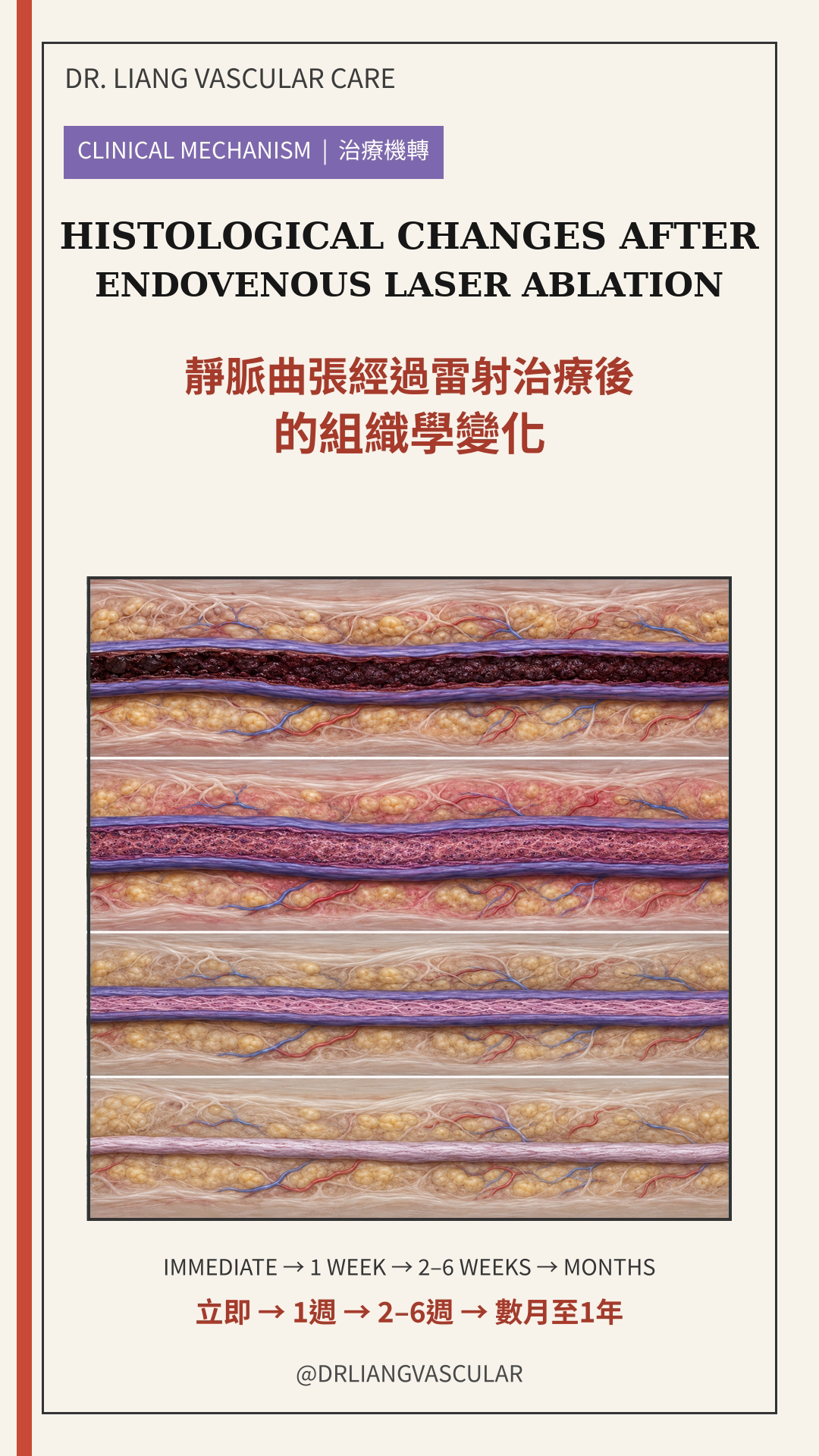
This process is not complete when the procedure ends. Early changes include wall injury, intraluminal coagulation and inflammation. The contents then organize, collagen increases, the lumen shrinks and the vein may ultimately become a thin fibrous cord.
- EVLA treats a refluxing superficial truncal vein; the vessel does not disappear immediately
- Early tightness, pulling or local tenderness may reflect inflammation and developing fibrosis
- Shrinkage takes weeks to months, and ultrasound follow-up assesses closure more reliably than surface appearance alone
Immediately after treatment: thermal closure
- Laser energy produces controlled thermal injury, causing the vein wall to contract and appose.
- Coagulated blood and thrombus may fill the lumen as part of the closure and remodelling process.
- Blood returns through other healthy veins after the refluxing superficial segment is closed.
Around one week: inflammation and repair
- Histological studies show inflammatory repair around the treated vein at approximately one week.
- Some people notice tightness, pulling, tenderness or a firm cord along the treated segment.
- These symptoms usually improve; worsening pain, marked redness, one-sided swelling or breathing symptoms require prompt assessment.
Two to six weeks: organization and fibrosis
- The intraluminal clot is replaced by repair tissue, followed by progressive collagen deposition and fibrosis.
- The vein gradually becomes smaller and may temporarily feel firm; symptom and appearance changes do not always occur at the same speed.
- Bruising and local reactions may be more noticeable when tributaries, phlebectomy or sclerotherapy are treated at the same session.
Months to one year: continued shrinkage
- Ongoing remodelling may reduce the closed vein to a thin fibrous cord.
- Follow-up studies report that some treated veins are difficult to identify on ultrasound by one year, although remodelling varies between individuals.
- Appearance, symptoms and ultrasound closure are separate outcomes and should be reviewed together.
Why are compression stockings commonly worn for at least two weeks?
- In our practice, stockings are commonly recommended for at least two weeks after EVLA to reduce early pain, swelling, bruising, tenderness and pulling, and to make walking and daily activity more comfortable.
- International guidelines generally support a minimum of one week after thermal ablation for pain reduction. Randomized trials also found that one to two weeks of compression can reduce early pain or analgesic use.
- A longer treatment segment, simultaneous treatment of bulging tributaries, phlebectomy or sclerotherapy may lead the clinician to extend compression to two weeks or longer according to bruising, swelling and work demands.
- Two weeks is an individualized postoperative plan—not a universal rule—and compression does not guarantee prevention of recanalization or recurrence. Pressure, stocking length, daily duration and total wear time should follow the treating clinician's instructions.
Tissue changes after EVLA
| Time | Change inside the vein | What you may notice |
|---|---|---|
| Immediately | Thermal wall injury, contraction and coagulation | Access-site discomfort or mild tightness |
| Around one week | Inflammation and repair | Pulling, tenderness or a firm cord |
| Two to six weeks | Organization and collagen deposition | Bruising and tightness gradually improve |
| Months to one year | Continued shrinkage into a fibrous cord | Symptoms and appearance become more stable |
Frequently asked questions
Does a firm cord mean that treatment failed?
Not necessarily. Early inflammation, organization and fibrosis may temporarily make the treated segment feel firm or tight. Ultrasound and symptoms should be reviewed together; marked redness, heat or worsening pain warrants earlier assessment.
Must everyone wear stockings for exactly two weeks?
No. Guidelines generally support at least one week after thermal ablation for pain reduction. In our practice, treatment length, simultaneous tributary treatment, bruising, swelling and daily needs may justify extending use to at least two weeks. Follow your individual postoperative instructions.
Do stockings prevent recanalization or recurrence?
They cannot guarantee this. Their main role is to improve early pain, swelling and comfort.
Will closing the vein impair leg circulation?
Standing ultrasound identifies the refluxing superficial vein before treatment. After it is closed, blood returns through other healthy veins.
Note: Seek urgent medical assessment for sudden marked one-sided swelling, worsening pain, chest pain, shortness of breath, heavy bleeding or fever after treatment.
References
- Vuylsteke M, et al. Histological changes in the saphenous vein after endovenous laser treatment. Int Angiol. 2009;28(4):272–277. PMID: 19620699. View source
- Proebstle TM, et al. Fate of the great saphenous vein following endovenous laser ablation: does it finally disappear? J Vasc Surg. 2008;48(1):173–178. PMID: 18474444. View source
- Gloviczki P, et al. The 2023 SVS/AVF/AVLS clinical practice guidelines for the management of varicose veins of the lower extremities. Part II. J Vasc Surg Venous Lymphat Disord. 2024;12(1):101670. View source
- Ye K, et al. Post-operative benefit of compression therapy after endovenous laser treatment for uncomplicated varicose veins: a randomised clinical trial. Eur J Vasc Endovasc Surg. 2016;52(6):847–853. PMID: 26993388. View source
- Bootun R, et al. Compression therapy after thermal ablation of varicose veins (COMETA): a randomised controlled trial. Ann Surg. 2021;273(2):232–239. PMID: 31850976. View source
- Bakker NA, et al. A prospective randomised trial of compression stockings after endovenous laser ablation of the great saphenous vein. Eur J Vasc Endovasc Surg. 2013;46(5):588–592. PMID: 24012465. View source
This article and animation provide general health education. The timeline summarizes research and clinical observations; recovery does not proceed at the same speed in every patient. Compression pressure, length and duration require individual assessment according to the procedure, additional treatment, skin condition and arterial circulation. Compression cannot guarantee prevention of recanalization, recurrence or complications.
Dr LiangVascular
Begin with a careful assessment.
Symptoms, examination and ultrasound findings are considered before treatment options are discussed.
Book an Appointment