Clinical Education
For suitable truncal reflux, minimally invasive treatment is often considered before open surgery. Surgery still has a role when anatomy or other factors make catheter treatment unsuitable.
- Ultrasound first, then treatment selection
- Open surgery usually involves more wounds and a longer recovery
- Minimally invasive treatment uses small access sites and usually allows faster recovery
- Laser and adhesive still require individual selection
Traditional high ligation and stripping
- The problem vein is tied through incisions and a segment is removed.
- It usually involves more incisions and a broader anaesthetic requirement.
- Bruising, pain and pulling are often more noticeable, with a longer return to daily activity.
- It can still be reasonable when anatomy is unsuitable for catheter treatment.
Advantages of minimally invasive treatment
- A catheter is inserted through a small access site without stripping out the whole vein.
- Local anaesthesia and smaller wounds are usually possible.
- Pain and bruising are generally less, with a faster return to walking and daily activity.
- Laser, medical adhesive or other techniques can be selected according to anatomy.
Laser or medical adhesive?
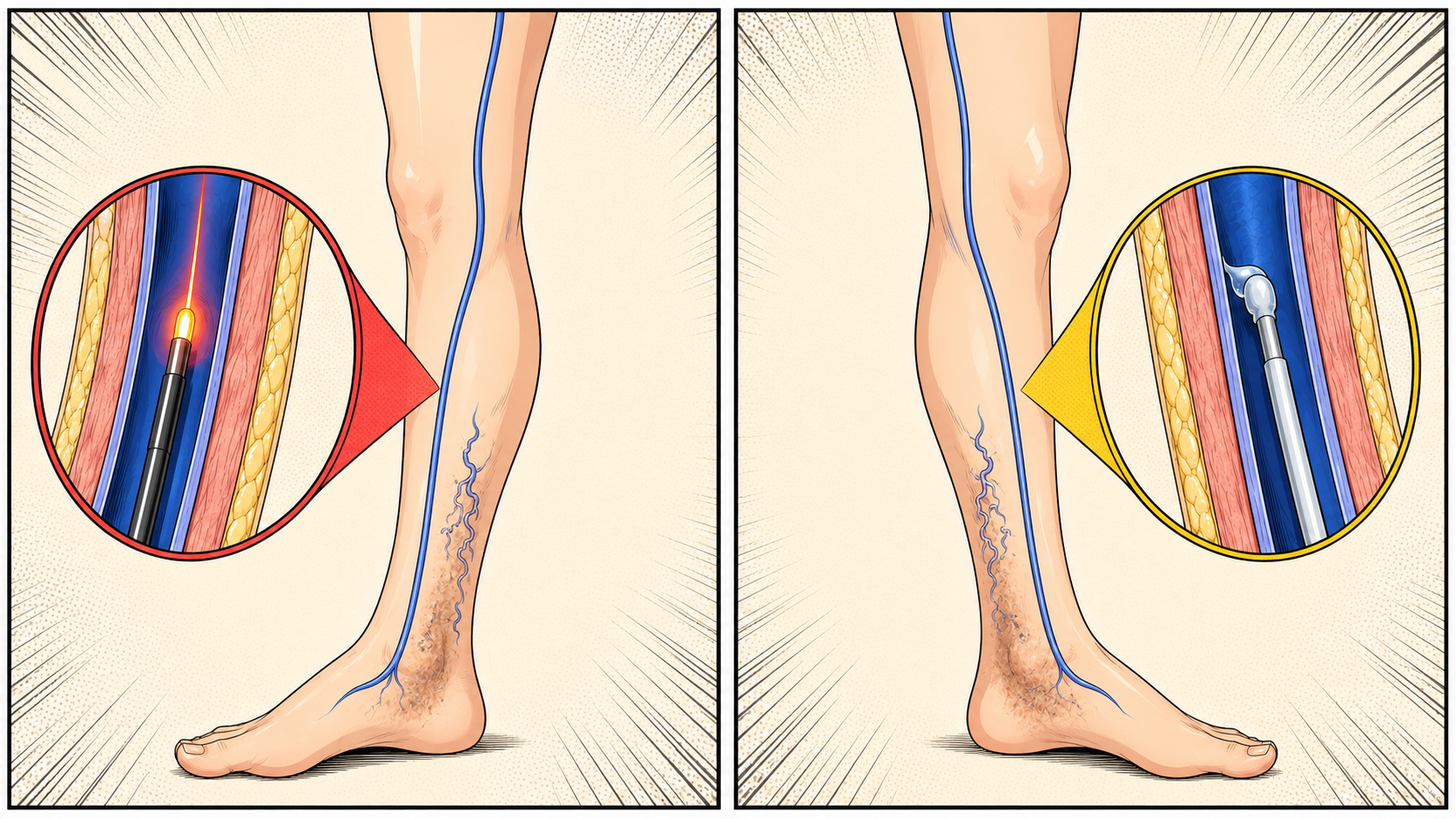
- Laser uses heat and tumescent anaesthesia; usual rest is 2–3 days, with 2–4 weeks of compression.
- Medical adhesive uses no heat or injections along the vein. Depending on the individual case and treatment, compression stockings may not be required after VenaSeal. If recommended, they are usually worn for up to 1 week.
- Allergy history, vein location and cost should also be discussed.
Traditional surgery vs laser vs medical adhesive
| Comparison | Traditional surgery | Laser | Medical adhesive |
|---|---|---|---|
| Method | Tie and remove the vein | Thermal closure | Adhesive closure |
| Wounds | Usually more and larger | Small access site | Small access site |
| Anaesthesia | Usually broader | Tumescent along the vein | Local at access site |
| Recovery | Usually slower | Usually 2–3 lighter days | Usually no special time off |
| Compression | Depends on surgery | Generally 2–4 weeks | May not be required; if recommended, usually up to 1 week |
Note: Minimally invasive treatment is not suitable for everyone, and open surgery is not always inappropriate. The best choice should match ultrasound anatomy and individual needs.
References
- Gloviczki P, et al. SVS/AVF/AVLS Guidelines Part I. J Vasc Surg Venous Lymphat Disord. 2023;11:231–261.e6. View source
- De Maeseneer MG, et al. ESVS 2022 Clinical Practice Guidelines. Eur J Vasc Endovasc Surg. 2022;63:184–267. View source
- Gibson K, et al. WAVES Study: cyanoacrylate closure without post-procedure compression. Vascular. 2017;25(2):149–156. View source
- Medtronic. VenaSeal Closure System: clinical information and post-procedure compression guidance. View source
This article is for health education only and does not replace individual medical assessment. Seek urgent care for acute symptoms.
Dr LiangVascular
Begin with a careful assessment.
Symptoms, examination and ultrasound findings are considered before treatment options are discussed.
Book an Appointment