中文版
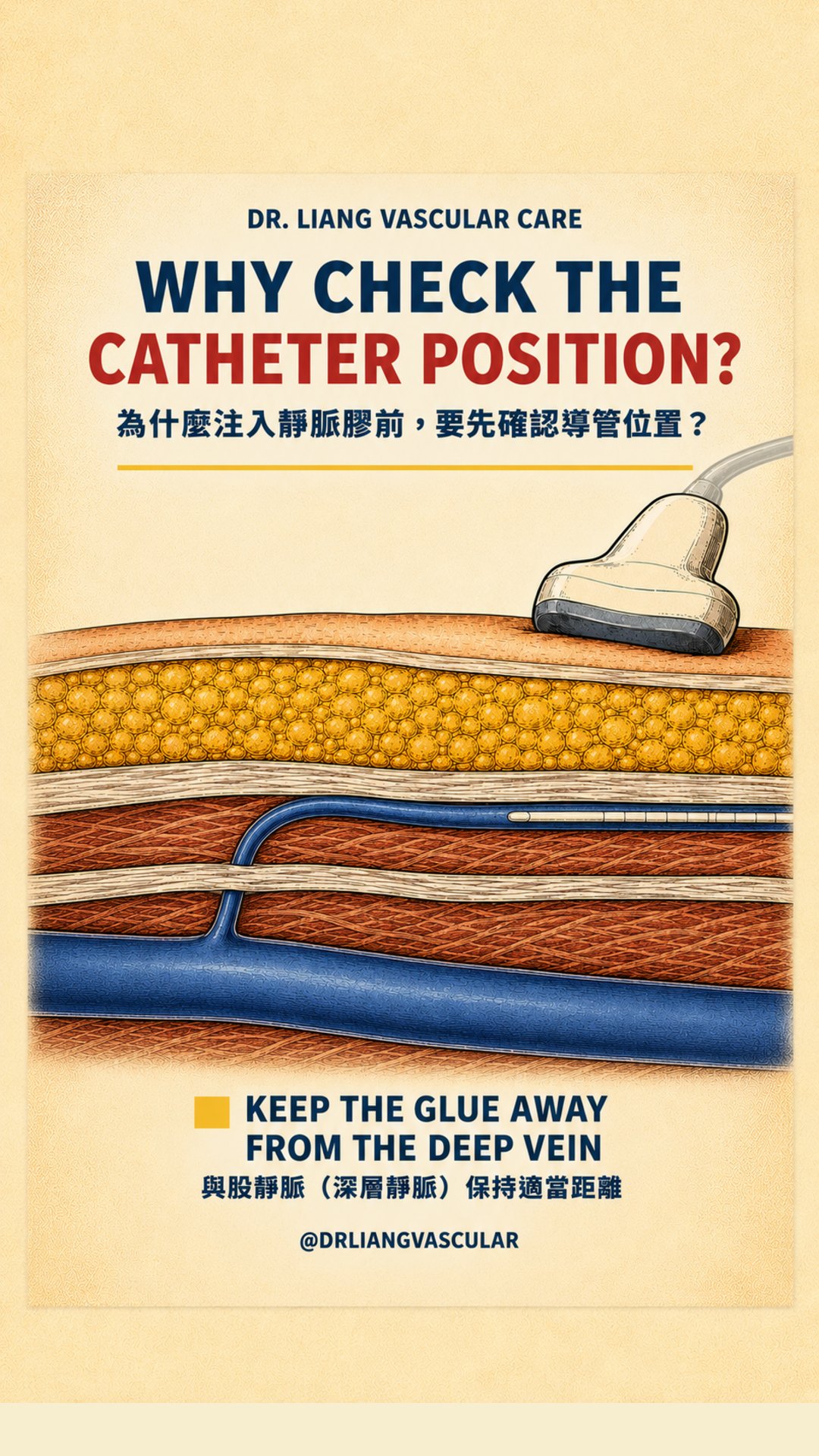
第一次注膠前,醫師會以超音波確認導管尖端仍位於預定治療的表淺靜脈內,並確認它與股隱靜脈交界的關係。依標準操作,導管尖端會定位在股隱靜脈交界遠端至少5公分,再開始分段注膠。
- 導管尖端應位於預定治療的表淺靜脈,而不是深層靜脈
- 超音波即時辨認導管尖端、股隱靜脈交界與深層靜脈
- 第一次注膠前,依標準操作確認沿血管至少5公分的定位距離
5公分到底從哪裡量?
- 不是從皮膚表面量,也不是導管到股靜脈的垂直距離。
- 這個距離是沿著大隱靜脈,由導管尖端量到股隱靜脈交界,也就是大隱靜脈匯入股靜脈的位置。
- 影片暫停並用箭頭標示,就是為了讓觀眾看清楚這個關鍵定位。
為什麼不能放好導管就立刻注膠?
- 導管送入後仍需再次確認尖端位置,避免位置過於接近深層靜脈交界。
- 適當定位有助於降低膠體或血栓向深層靜脈延伸的風險。
- 確認完成後,才依操作規範分段注膠、按壓並逐步退出導管。
超音波在這一步確認什麼?
- 預定治療的是哪一條表淺靜脈,以及導管是否位於該血管內。
- 導管尖端、股隱靜脈交界與股靜脈的位置關係。
- 定位距離是否符合預定操作,再決定是否進入下一步。
每位病人都適合VenaSeal嗎?
- 不一定。是否適合需結合症狀、站立式超音波、血管走向與直徑、過敏史及其他個人因素評估。
- 不同血管型態可能適合VenaSeal、熱消融、硬化劑、微創靜脈摘除或其他處理方式。
- 技術步驟與術後追蹤也會依個人血管條件調整。
第一次注膠前的三個確認
| 確認項目 | 超音波要看到什麼 | 目的 |
|---|---|---|
| 目標血管 | 預定治療的表淺靜脈 | 避免誤入深層靜脈 |
| 導管尖端 | 尖端在目標靜脈內的清楚位置 | 確認可控制的起始點 |
| 交界與距離 | 股隱靜脈交界,以及沿血管至少5公分的距離 | 避免起始點過於接近深層靜脈 |
常見問題
5公分是從皮膚表面量嗎?
不是。是沿著血管,由導管尖端量到股隱靜脈交界的距離。
導管會進入股靜脈嗎?
治療導管定位在預定處理的表淺靜脈內。注膠前會以超音波辨認股隱靜脈交界與深層靜脈,確認尖端位置。
導管已經放進去,為什麼還要再照超音波?
真正開始注膠前,需要再次確認尖端位置與交界距離。這是操作安全檢查的一部分。
所有靜脈曲張都能用VenaSeal嗎?
不能只靠外觀決定。是否適合仍需依症狀、站立式超音波、血管條件、過敏史及替代方案個別評估。
提醒:本文展示的是醫療流程中的定位概念,不是自行操作教學。實際導管位置、治療方式與安全檢查需由合格醫療人員依產品說明及個別血管條件執行。
English
Before the first adhesive delivery, ultrasound confirms that the catheter tip remains within the intended superficial target vein and shows its relationship to the saphenofemoral junction. Under the standard instructions for use, the tip is positioned at least 5 cm distal to the junction before segmental adhesive delivery begins.
- The catheter tip stays in the intended superficial target vein—not the deep vein
- Ultrasound identifies the tip, saphenofemoral junction and deep vein in real time
- Before the first adhesive delivery, the standard protocol confirms at least 5 cm along the vein
Where is the 5 cm measured?
- It is not measured from the skin and is not a perpendicular distance to the femoral vein.
- It is measured along the great saphenous vein from the catheter tip to the saphenofemoral junction, where the GSV meets the femoral vein.
- The pause and arrow in the video make this positioning step easier to understand.
Why not deliver adhesive immediately?
- After catheter advancement, the tip is checked again so that it is not too close to the deep-vein junction.
- Appropriate positioning helps reduce the risk of adhesive or thrombus extending toward the deep venous system.
- Only after confirmation does controlled, segmental adhesive delivery and catheter withdrawal begin.
What does ultrasound confirm?
- The superficial vein selected for treatment and whether the catheter is inside that vessel.
- The positions of the catheter tip, saphenofemoral junction and femoral vein.
- Whether the planned positioning distance has been achieved before proceeding.
Is VenaSeal suitable for everyone?
- No. Suitability depends on symptoms, standing ultrasound, venous anatomy and diameter, allergy history and other individual factors.
- Different patterns may be better treated with VenaSeal, thermal ablation, sclerotherapy, microphlebectomy or another approach.
- Technical details and follow-up are individualized.
Three checks before the first adhesive delivery
| Check | What ultrasound should show | Why it matters |
|---|---|---|
| Target vein | The intended superficial vein | Avoid entry into the deep vein |
| Catheter tip | A clear tip position within the target vein | Establish a controlled starting point |
| Junction and distance | The SFJ and at least 5 cm measured along the vein | Avoid starting too close to the deep venous system |
Frequently asked questions
Is the 5 cm measured from the skin?
No. It is measured along the vein from the catheter tip to the saphenofemoral junction.
Does the treatment catheter enter the femoral vein?
The catheter is positioned within the superficial target vein. Ultrasound identifies the junction and deep vein before adhesive delivery.
Why use ultrasound again after the catheter is inserted?
The tip position and junction distance must be reconfirmed immediately before adhesive delivery. This is part of the procedural safety check.
Can every varicose vein be treated with VenaSeal?
No. Suitability requires individual assessment of symptoms, standing-ultrasound findings, venous anatomy, allergy history and alternatives.
Note: This article explains a positioning concept within a medical procedure; it is not a self-treatment guide. Qualified clinicians must determine catheter position, treatment and safety checks according to the instructions for use and individual anatomy.
References
- Medtronic. VenaSeal Closure System: product information and Instructions for Use resources. 查看來源
- Lee J, et al. Can the great saphenous vein be ablated closer than 5 cm to the saphenofemoral junction using cyanoacrylate? J Vasc Surg Venous Lymphat Disord. 2024. PMID: 38155556. 查看來源
- Gloviczki P, Lawrence PF, Wasan SM, et al. The 2023 Society for Vascular Surgery, American Venous Forum, and American Vein and Lymphatic Society clinical practice guidelines for the management of varicose veins of the lower extremities. Part II. J Vasc Surg Venous Lymphat Disord. 2024;12(1):101670. 查看來源
- De Maeseneer MG, Kakkos SK, Aherne T, et al. European Society for Vascular Surgery (ESVS) 2022 Clinical Practice Guidelines on the Management of Chronic Venous Disease of the Lower Limbs. Eur J Vasc Endovasc Surg. 2022;63(2):184–267. 查看來源
本文與影片提供一般衛教,不代表每位病人都適合VenaSeal,也不保證特定療效或零風險。實際導管位置、治療方式、風險與恢復需依產品仿單、症狀、站立式超音波及個人狀況評估。
Dr LiangVascular
從完整評估開始
先整合症狀、理學檢查與超音波結果,再討論適合的治療選擇。
預約門診