Clinical Education
The sections below separate guideline recommendations from my practical clinical interpretation, so the choice is easier to understand.
- Guideline recommendation: for aching, heaviness or discomfort after prolonged standing, medical compression providing at least 15 mmHg at the ankle may help.
- Guideline recommendation: ankle or lower-leg oedema is generally treated with 20–40 mmHg; severe skin change or a venous ulcer needs professional assessment.
- Dr LiangVascular’s clinical interpretation: when symptoms are mainly below the knee, a knee-high stocking is often the most practical place to start.
How much pressure do you need?
- For aching, heaviness or discomfort after prolonged standing, the ESVS guideline recommends considering medical compression that provides at least 15 mmHg at the ankle.
- For ankle or lower-leg oedema, 20–40 mmHg is generally recommended.
- Severe skin changes or a venous ulcer may require stronger or more structured compression treatment selected by a healthcare professional.
- Compression that is too weak may offer little relief, while excessive pressure may be difficult to tolerate and can cause numbness, pain or pressure injury. Correct fit and consistent use matter more than choosing the highest pressure.
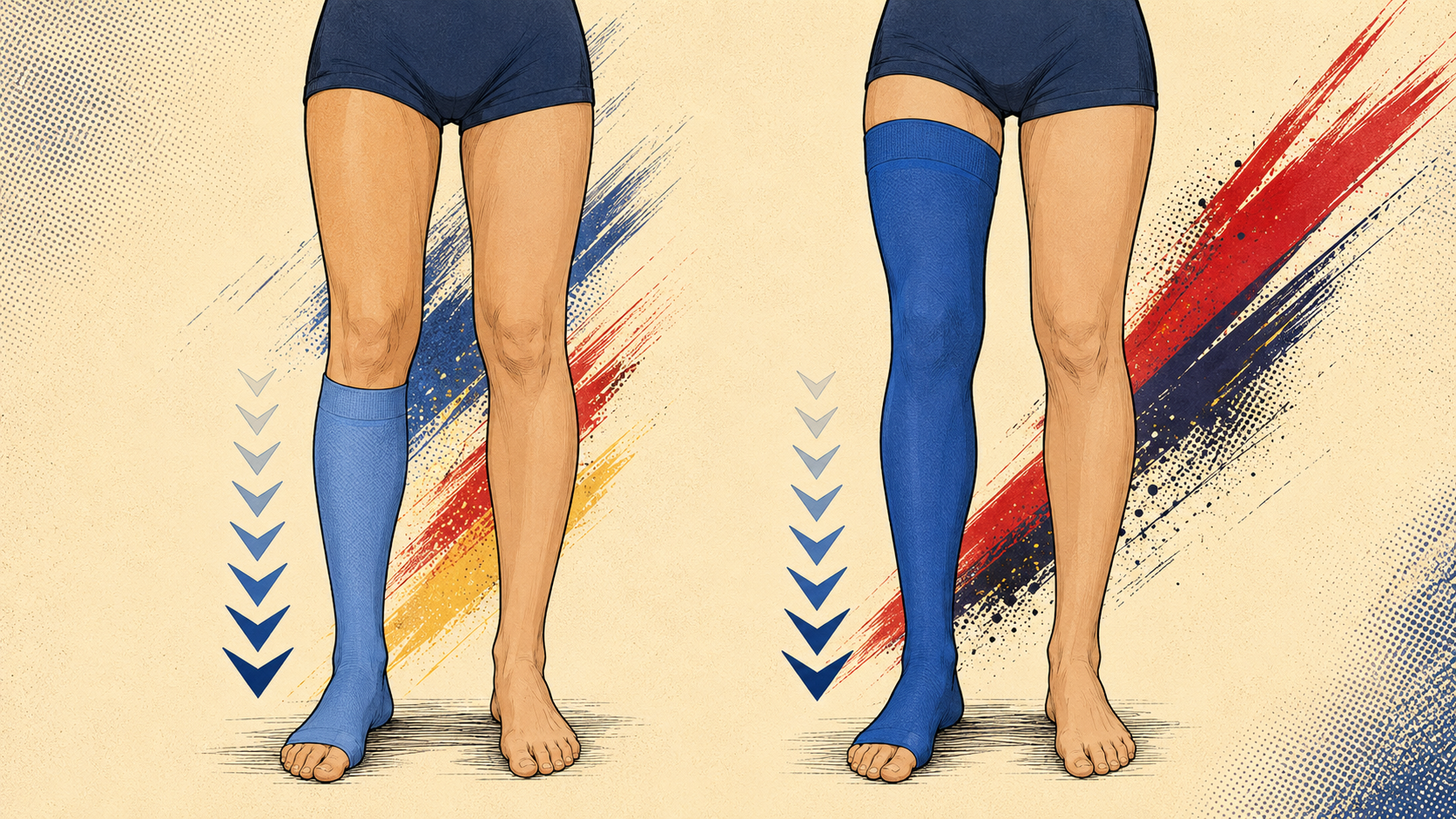
Knee-high or thigh-high?
- For most people whose main symptoms are ankle swelling, calf aching or heaviness, a knee-high stocking is easier to apply and less likely to slip.
- A thigh-high stocking may be considered when symptoms, swelling or the treated area extend above the knee.
- There is no single best length for everyone. The choice should match symptom location, ultrasound findings and the treatment plan.
Can stockings cure varicose veins?
- Compression can reduce aching, swelling and heaviness, but it cannot repair a damaged venous valve or remove established reflux.
- The SVS/AVF/AVLS guideline states that for suitable patients with symptomatic axial reflux confirmed by ultrasound, long-term compression should not automatically replace appropriate venous intervention.
- The decision should consider symptoms, ultrasound findings, daily activities and personal preference.
Who should not choose compression without assessment?
- Seek medical advice first if you have a cold foot, pain at rest, known peripheral arterial disease, significant neuropathy, severe heart failure or an open wound.
- For the first fitting, measure the ankle and calf in the morning rather than choosing by shoe size alone.
- A stocking is not suitable if it rolls into a tight band or causes numbness, colour change or pain.
- Start with a stocking that fits correctly and that you can actually wear. Pressure and length can then be adjusted to your symptoms and ultrasound findings.
A quick guide to stocking length and pressure
| Situation | Typical choice | Important note |
|---|---|---|
| Aching, heaviness or standing discomfort | At least 15 mmHg; often knee-high | Correct sizing matters |
| Ankle or lower-leg oedema | 20–40 mmHg | Check arterial circulation first |
| Symptoms or treatment above the knee | Consider thigh-high after assessment | Longer is not automatically better |
| Severe skin change or venous ulcer | Specialist compression | Do not self-select high pressure |
Note: Sudden one-sided leg swelling or pain, chest pain, or shortness of breath requires urgent medical care. Compression stockings do not replace assessment for a blood clot or another emergency.
References
- De Maeseneer MG, Kakkos SK, Aherne T, et al. European Society for Vascular Surgery (ESVS) 2022 Clinical Practice Guidelines on the Management of Chronic Venous Disease of the Lower Limbs. Eur J Vasc Endovasc Surg. 2022;63(2):184–267. DOI: 10.1016/j.ejvs.2021.12.024. View source
- Gloviczki P, Lawrence PF, Wasan SM, et al. The 2023 Society for Vascular Surgery, American Venous Forum, and American Vein and Lymphatic Society Clinical Practice Guidelines for the Management of Varicose Veins of the Lower Extremities. Part II. J Vasc Surg Venous Lymphat Disord. 2024;12(1):101670. DOI: 10.1016/j.jvsv.2023.08.011. View source
- Lurie F, Lal BK, Antignani PL, et al. Compression Therapy After Invasive Treatment of Superficial Veins of the Lower Extremities: Clinical Practice Guidelines. J Vasc Surg Venous Lymphat Disord. 2019;7(1):17–28. DOI: 10.1016/j.jvsv.2018.10.002. View source
This article is for health education only and does not replace individual medical assessment. Seek urgent care for acute symptoms.
Dr LiangVascular
Begin with a careful assessment.
Symptoms, examination and ultrasound findings are considered before treatment options are discussed.
Book an Appointment