中文版
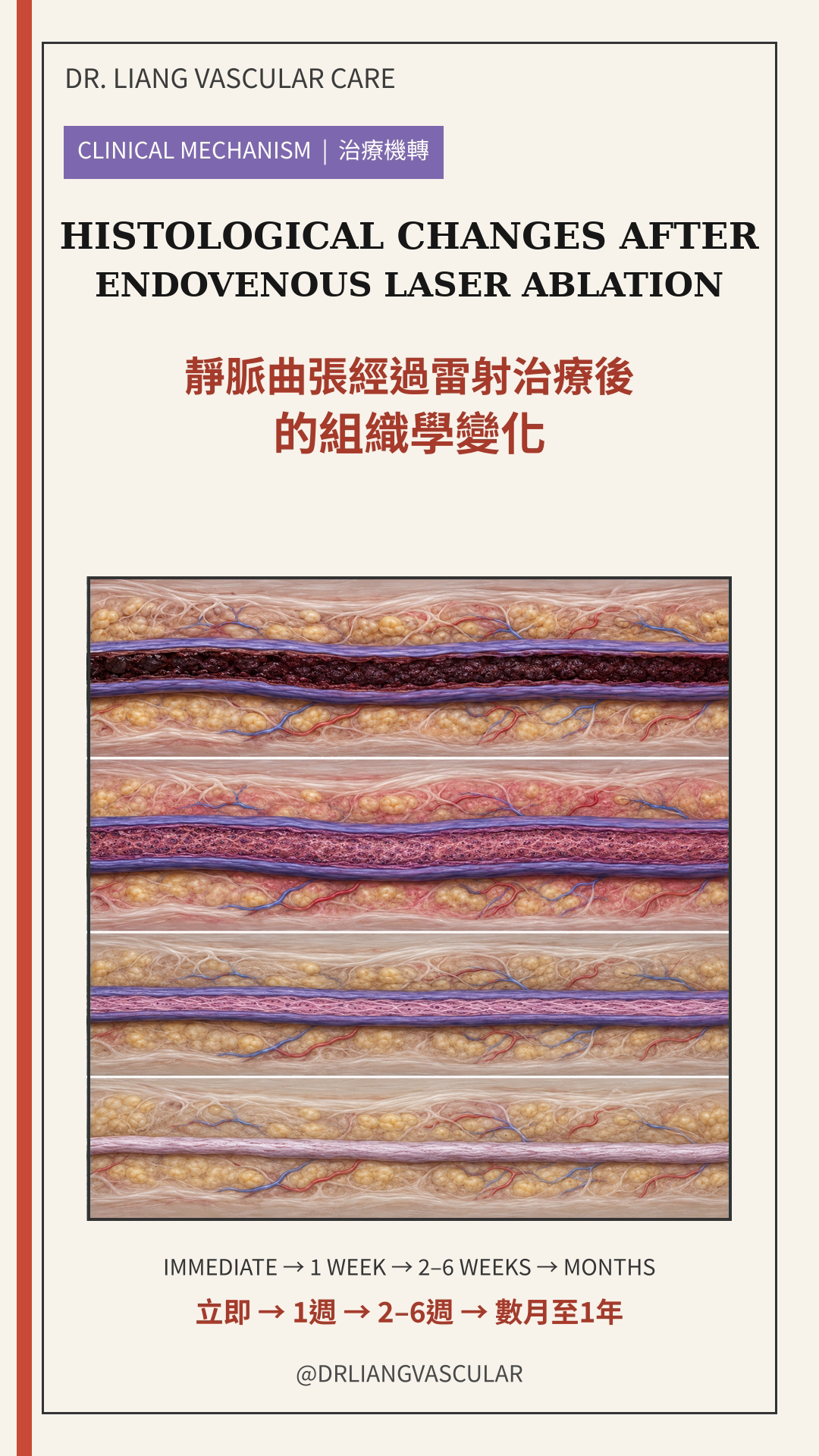
這個變化不是在治療結束時就全部完成。早期可出現血管壁損傷、腔內凝血與局部發炎;接著血栓逐漸組織化、膠原增加,血管管腔縮小,最後可能變成較細的纖維索。
- 雷射主要處理有逆流的表淺靜脈主幹,不是把整條血管立即『消失』
- 治療後的緊繃、拉扯或局部壓痛,可能與早期發炎修復及纖維化有關
- 血管縮小需要數週至數月;超音波追蹤比只看皮膚表面更能確認閉合情況
治療當下:血管壁受熱並閉合
- 雷射能量在血管內作用,使血管壁產生受控的熱損傷、收縮並貼合。
- 腔內可見凝血與血栓形成;這是閉合與後續重塑過程的一部分。
- 閉合後,腿部血液會改由功能正常的靜脈回流。
約一週:進入發炎與修復期
- 病理研究顯示,治療後一週可見血管周邊的發炎修復反應。
- 部分人會感到沿治療血管的局部緊繃、拉扯、壓痛或摸到較硬的線條。
- 不適通常會逐步改善,但若疼痛加劇、紅腫明顯、單側腫脹或呼吸不適,應盡快回診或就醫。
二至六週:血栓組織化,膠原逐漸增加
- 腔內凝血會被修復組織取代,形成肉芽組織並逐步纖維化。
- 血管直徑會慢慢變小,觸感可能一度較硬;外觀和感受的改善速度不一定一致。
- 若同時處理凸起分支、進行微創靜脈摘除或硬化劑治療,瘀青與局部反應可能更明顯。
數月至一年:持續收縮與纖維化
- 隨著重塑持續,已閉合的血管可逐漸縮成較細的纖維索。
- 追蹤研究顯示,部分治療血管在一年超音波下已不容易辨認;但每個人的血管條件與重塑速度不同。
- 外觀改善、症狀改善與超音波閉合是不同面向,追蹤時要一起評估。
為什麼雷射後通常建議至少穿兩週彈性襪?
- 本院在雷射治療後通常建議至少穿兩週,主要目的在減輕早期疼痛、腫脹、瘀青、局部壓痛與拉扯感,並讓走路及日常活動更舒適。
- 國際指引對熱消融後的最低建議多為至少一週,重點是減輕早期疼痛;隨機試驗也顯示,穿一至兩週可在治療後早期降低疼痛或止痛藥使用。
- 若治療範圍較長,或同時處理凸起分支、進行微創靜脈摘除或硬化劑治療,醫師可能依腫脹、瘀青與工作需求把穿著時間延長至兩週以上。
- 兩週不是所有病人都固定相同的硬性規定,也不能保證防止血管再通或復發。實際壓力、襪長、每日穿著時間及總天數,應依治療範圍、皮膚狀況、動脈循環與回診評估調整。
雷射治療後的組織變化時間軸
| 時間 | 血管內的變化 | 可能感受到的變化 |
|---|---|---|
| 治療當下 | 血管壁熱損傷、收縮與腔內凝血 | 穿刺點不適、輕微緊繃 |
| 約一週 | 發炎與修復反應 | 拉扯、壓痛或硬條感 |
| 二至六週 | 血栓組織化、膠原增加 | 瘀青與緊繃逐步改善 |
| 數月至一年 | 持續收縮並形成纖維索 | 症狀與外觀逐步穩定 |
常見問題
治療後摸到硬硬的一條,是治療失敗嗎?
不一定。早期的發炎修復、血栓組織化及纖維化都可能讓治療區暫時較硬或有拉扯感。仍應依症狀與超音波追蹤判斷;若紅腫熱痛明顯或症狀惡化,請提前回診。
彈性襪一定要穿滿兩週嗎?
不是所有人都完全相同。國際指引多支持熱消融後至少一週以減輕疼痛;本院常依治療長度、是否同時處理分支、瘀青腫脹及生活需求,建議延長到至少兩週。請以個別術後指示為準。
穿彈性襪可以保證不再通或不復發嗎?
不能。彈性襪主要幫助早期疼痛、腫脹與舒適度,不能保證避免再通、復發或新血管出現。
閉合的靜脈會影響腿部回流嗎?
治療前會以站立式超音波確認要處理的是有逆流的表淺靜脈。閉合後,血液會改由功能正常的靜脈回流。
提醒:雷射後若出現突然單側明顯腫脹、持續加劇的疼痛、胸痛、呼吸困難、傷口大量出血或發燒,請立即聯絡醫療院所或就近就醫。
English
This process is not complete when the procedure ends. Early changes include wall injury, intraluminal coagulation and inflammation. The contents then organize, collagen increases, the lumen shrinks and the vein may ultimately become a thin fibrous cord.
- EVLA treats a refluxing superficial truncal vein; the vessel does not disappear immediately
- Early tightness, pulling or local tenderness may reflect inflammation and developing fibrosis
- Shrinkage takes weeks to months, and ultrasound follow-up assesses closure more reliably than surface appearance alone
Immediately after treatment: thermal closure
- Laser energy produces controlled thermal injury, causing the vein wall to contract and appose.
- Coagulated blood and thrombus may fill the lumen as part of the closure and remodelling process.
- Blood returns through other healthy veins after the refluxing superficial segment is closed.
Around one week: inflammation and repair
- Histological studies show inflammatory repair around the treated vein at approximately one week.
- Some people notice tightness, pulling, tenderness or a firm cord along the treated segment.
- These symptoms usually improve; worsening pain, marked redness, one-sided swelling or breathing symptoms require prompt assessment.
Two to six weeks: organization and fibrosis
- The intraluminal clot is replaced by repair tissue, followed by progressive collagen deposition and fibrosis.
- The vein gradually becomes smaller and may temporarily feel firm; symptom and appearance changes do not always occur at the same speed.
- Bruising and local reactions may be more noticeable when tributaries, phlebectomy or sclerotherapy are treated at the same session.
Months to one year: continued shrinkage
- Ongoing remodelling may reduce the closed vein to a thin fibrous cord.
- Follow-up studies report that some treated veins are difficult to identify on ultrasound by one year, although remodelling varies between individuals.
- Appearance, symptoms and ultrasound closure are separate outcomes and should be reviewed together.
Why are compression stockings commonly worn for at least two weeks?
- In our practice, stockings are commonly recommended for at least two weeks after EVLA to reduce early pain, swelling, bruising, tenderness and pulling, and to make walking and daily activity more comfortable.
- International guidelines generally support a minimum of one week after thermal ablation for pain reduction. Randomized trials also found that one to two weeks of compression can reduce early pain or analgesic use.
- A longer treatment segment, simultaneous treatment of bulging tributaries, phlebectomy or sclerotherapy may lead the clinician to extend compression to two weeks or longer according to bruising, swelling and work demands.
- Two weeks is an individualized postoperative plan—not a universal rule—and compression does not guarantee prevention of recanalization or recurrence. Pressure, stocking length, daily duration and total wear time should follow the treating clinician's instructions.
Tissue changes after EVLA
| Time | Change inside the vein | What you may notice |
|---|---|---|
| Immediately | Thermal wall injury, contraction and coagulation | Access-site discomfort or mild tightness |
| Around one week | Inflammation and repair | Pulling, tenderness or a firm cord |
| Two to six weeks | Organization and collagen deposition | Bruising and tightness gradually improve |
| Months to one year | Continued shrinkage into a fibrous cord | Symptoms and appearance become more stable |
Frequently asked questions
Does a firm cord mean that treatment failed?
Not necessarily. Early inflammation, organization and fibrosis may temporarily make the treated segment feel firm or tight. Ultrasound and symptoms should be reviewed together; marked redness, heat or worsening pain warrants earlier assessment.
Must everyone wear stockings for exactly two weeks?
No. Guidelines generally support at least one week after thermal ablation for pain reduction. In our practice, treatment length, simultaneous tributary treatment, bruising, swelling and daily needs may justify extending use to at least two weeks. Follow your individual postoperative instructions.
Do stockings prevent recanalization or recurrence?
They cannot guarantee this. Their main role is to improve early pain, swelling and comfort.
Will closing the vein impair leg circulation?
Standing ultrasound identifies the refluxing superficial vein before treatment. After it is closed, blood returns through other healthy veins.
Note: Seek urgent medical assessment for sudden marked one-sided swelling, worsening pain, chest pain, shortness of breath, heavy bleeding or fever after treatment.
References
- Vuylsteke M, et al. Histological changes in the saphenous vein after endovenous laser treatment. Int Angiol. 2009;28(4):272–277. PMID: 19620699. 查看來源
- Proebstle TM, et al. Fate of the great saphenous vein following endovenous laser ablation: does it finally disappear? J Vasc Surg. 2008;48(1):173–178. PMID: 18474444. 查看來源
- Gloviczki P, et al. The 2023 SVS/AVF/AVLS clinical practice guidelines for the management of varicose veins of the lower extremities. Part II. J Vasc Surg Venous Lymphat Disord. 2024;12(1):101670. 查看來源
- Ye K, et al. Post-operative benefit of compression therapy after endovenous laser treatment for uncomplicated varicose veins: a randomised clinical trial. Eur J Vasc Endovasc Surg. 2016;52(6):847–853. PMID: 26993388. 查看來源
- Bootun R, et al. Compression therapy after thermal ablation of varicose veins (COMETA): a randomised controlled trial. Ann Surg. 2021;273(2):232–239. PMID: 31850976. 查看來源
- Bakker NA, et al. A prospective randomised trial of compression stockings after endovenous laser ablation of the great saphenous vein. Eur J Vasc Endovasc Surg. 2013;46(5):588–592. PMID: 24012465. 查看來源
本文與動畫提供一般衛教,時間軸為研究與臨床觀察的概括,不代表每位病人都以相同速度恢復。彈性襪的壓力、長度與穿著天數需依治療方式、合併處置、皮膚與動脈循環狀況個別評估;不能保證避免再通、復發或併發症。
Dr LiangVascular
從完整評估開始
先整合症狀、理學檢查與超音波結果,再討論適合的治療選擇。
預約門診