中文版
這篇把指引建議、研究結果與我的臨床解讀分開說明,讓你比較容易選到穿得住、也穿得安全的彈性襪。
- 指引建議:腿痠、沉重或久站不舒服,可考慮腳踝壓力至少15 mmHg的醫療彈性襪。
- 指引建議:已有腳踝或小腿水腫,通常使用20–40 mmHg;嚴重皮膚變化或靜脈潰瘍需要專業評估。
- 梁筑鈞醫師的臨床解讀:多數症狀集中在小腿與腳踝的人,可先考慮較容易穿著的膝下型。
壓力怎麼選?
- 只有腿痠、沉重或久站不舒服:依ESVS指引,可考慮腳踝壓力至少15 mmHg的醫療彈性襪。
- 已有腳踝或小腿水腫:通常需要20–40 mmHg。
- 已有嚴重皮膚變化或靜脈潰瘍:可能需要更完整、壓力更高的治療,但不適合自己購買,應先由醫療人員評估。
- 壓力太低可能效果不明顯,太高則可能穿不住,甚至造成腳趾麻木、疼痛或皮膚壓傷。能正確穿著並持續使用,比一味追求高壓更重要。
要穿膝下還是大腿襪?
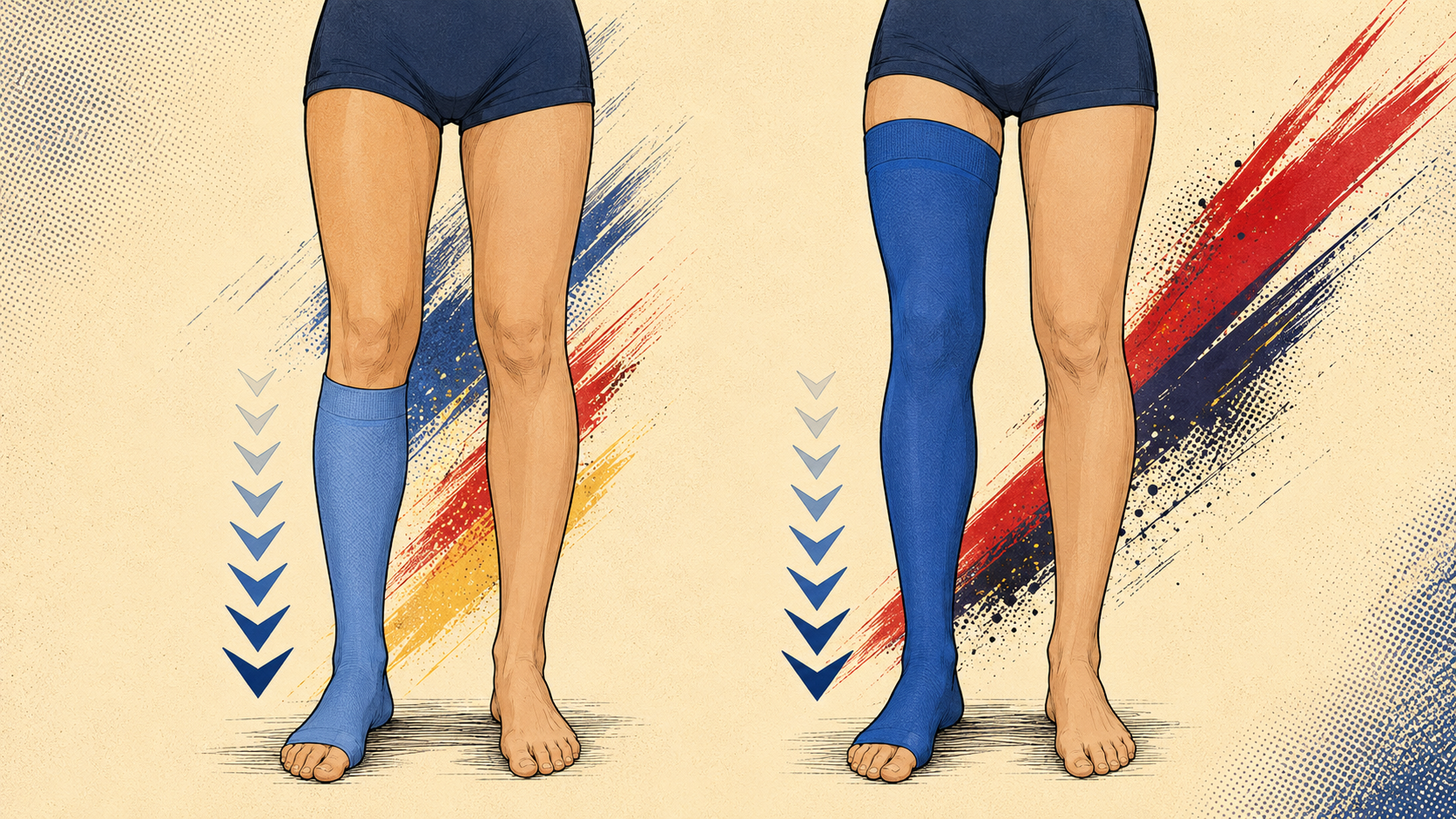
- 多數以腳踝腫脹、小腿痠沉為主的人,膝下襪通常較容易穿,也比較不會滑落。
- 若曲張血管、腫脹或治療範圍延伸到膝蓋以上,才可能考慮大腿襪。
- 這部分沒有所有人都一樣的答案,應按照症狀位置、超音波結果與治療範圍決定。
彈性襪可以治好靜脈曲張嗎?
- 彈性襪可以幫助減輕痠、腫與沉重感,但不能讓已失去功能的靜脈瓣膜恢復,也無法消除血液逆流。
- SVS/AVF/AVLS指引指出,若病人適合接受介入治療,且超音波已確認主幹靜脈逆流,不應把長期穿彈性襪當成唯一必要選擇。
- 是否治療,仍需綜合症狀、超音波、生活需求與個人意願。
哪些人不要自行購買?
- 若有腳冰冷、休息時仍疼痛、已知下肢動脈阻塞、明顯神經病變、嚴重心臟衰竭或皮膚傷口,請先接受評估。
- 第一次購買時,最好早上量腳踝及小腿尺寸,不要只看鞋子尺寸。
- 襪子若捲成一圈、勒出深痕,或穿後出現麻木、變色與疼痛,就不算合適。
- 先選穿得住、穿得對的彈性襪,再依症狀與超音波結果調整,不必一開始就買最緊、最長的款式。
彈性襪長度與壓力快速對照
| 你的情況 | 常見選擇 | 重要提醒 |
|---|---|---|
| 腿痠、沉重或久站不舒服 | 至少15 mmHg;多數先選膝下型 | 依尺寸正確穿著 |
| 腳踝或小腿水腫 | 20–40 mmHg | 建議先確認動脈循環 |
| 症狀或治療範圍超過膝蓋 | 依評估考慮大腿型 | 大腿型不一定比較有效 |
| 嚴重皮膚變化或靜脈潰瘍 | 專業壓力治療 | 不要自行購買高壓襪 |
提醒:如果單側腿部突然腫痛,或合併胸痛、呼吸困難,請立即就醫。彈性襪不能取代血栓或其他急症的評估。
English
The sections below separate guideline recommendations from my practical clinical interpretation, so the choice is easier to understand.
- Guideline recommendation: for aching, heaviness or discomfort after prolonged standing, medical compression providing at least 15 mmHg at the ankle may help.
- Guideline recommendation: ankle or lower-leg oedema is generally treated with 20–40 mmHg; severe skin change or a venous ulcer needs professional assessment.
- Dr LiangVascular’s clinical interpretation: when symptoms are mainly below the knee, a knee-high stocking is often the most practical place to start.
How much pressure do you need?
- For aching, heaviness or discomfort after prolonged standing, the ESVS guideline recommends considering medical compression that provides at least 15 mmHg at the ankle.
- For ankle or lower-leg oedema, 20–40 mmHg is generally recommended.
- Severe skin changes or a venous ulcer may require stronger or more structured compression treatment selected by a healthcare professional.
- Compression that is too weak may offer little relief, while excessive pressure may be difficult to tolerate and can cause numbness, pain or pressure injury. Correct fit and consistent use matter more than choosing the highest pressure.
Knee-high or thigh-high?
- For most people whose main symptoms are ankle swelling, calf aching or heaviness, a knee-high stocking is easier to apply and less likely to slip.
- A thigh-high stocking may be considered when symptoms, swelling or the treated area extend above the knee.
- There is no single best length for everyone. The choice should match symptom location, ultrasound findings and the treatment plan.
Can stockings cure varicose veins?
- Compression can reduce aching, swelling and heaviness, but it cannot repair a damaged venous valve or remove established reflux.
- The SVS/AVF/AVLS guideline states that for suitable patients with symptomatic axial reflux confirmed by ultrasound, long-term compression should not automatically replace appropriate venous intervention.
- The decision should consider symptoms, ultrasound findings, daily activities and personal preference.
Who should not choose compression without assessment?
- Seek medical advice first if you have a cold foot, pain at rest, known peripheral arterial disease, significant neuropathy, severe heart failure or an open wound.
- For the first fitting, measure the ankle and calf in the morning rather than choosing by shoe size alone.
- A stocking is not suitable if it rolls into a tight band or causes numbness, colour change or pain.
- Start with a stocking that fits correctly and that you can actually wear. Pressure and length can then be adjusted to your symptoms and ultrasound findings.
A quick guide to stocking length and pressure
| Situation | Typical choice | Important note |
|---|---|---|
| Aching, heaviness or standing discomfort | At least 15 mmHg; often knee-high | Correct sizing matters |
| Ankle or lower-leg oedema | 20–40 mmHg | Check arterial circulation first |
| Symptoms or treatment above the knee | Consider thigh-high after assessment | Longer is not automatically better |
| Severe skin change or venous ulcer | Specialist compression | Do not self-select high pressure |
Note: Sudden one-sided leg swelling or pain, chest pain, or shortness of breath requires urgent medical care. Compression stockings do not replace assessment for a blood clot or another emergency.
References
- De Maeseneer MG, Kakkos SK, Aherne T, et al. European Society for Vascular Surgery (ESVS) 2022 Clinical Practice Guidelines on the Management of Chronic Venous Disease of the Lower Limbs. Eur J Vasc Endovasc Surg. 2022;63(2):184–267. DOI: 10.1016/j.ejvs.2021.12.024. 查看來源
- Gloviczki P, Lawrence PF, Wasan SM, et al. The 2023 Society for Vascular Surgery, American Venous Forum, and American Vein and Lymphatic Society Clinical Practice Guidelines for the Management of Varicose Veins of the Lower Extremities. Part II. J Vasc Surg Venous Lymphat Disord. 2024;12(1):101670. DOI: 10.1016/j.jvsv.2023.08.011. 查看來源
- Lurie F, Lal BK, Antignani PL, et al. Compression Therapy After Invasive Treatment of Superficial Veins of the Lower Extremities: Clinical Practice Guidelines. J Vasc Surg Venous Lymphat Disord. 2019;7(1):17–28. DOI: 10.1016/j.jvsv.2018.10.002. 查看來源
本文提供一般衛教,不取代個別診斷或治療。若有急性不舒服,請先就近就醫。
Dr LiangVascular
從完整評估開始
先整合症狀、理學檢查與超音波結果,再討論適合的治療選擇。
預約門診