Clinical Education
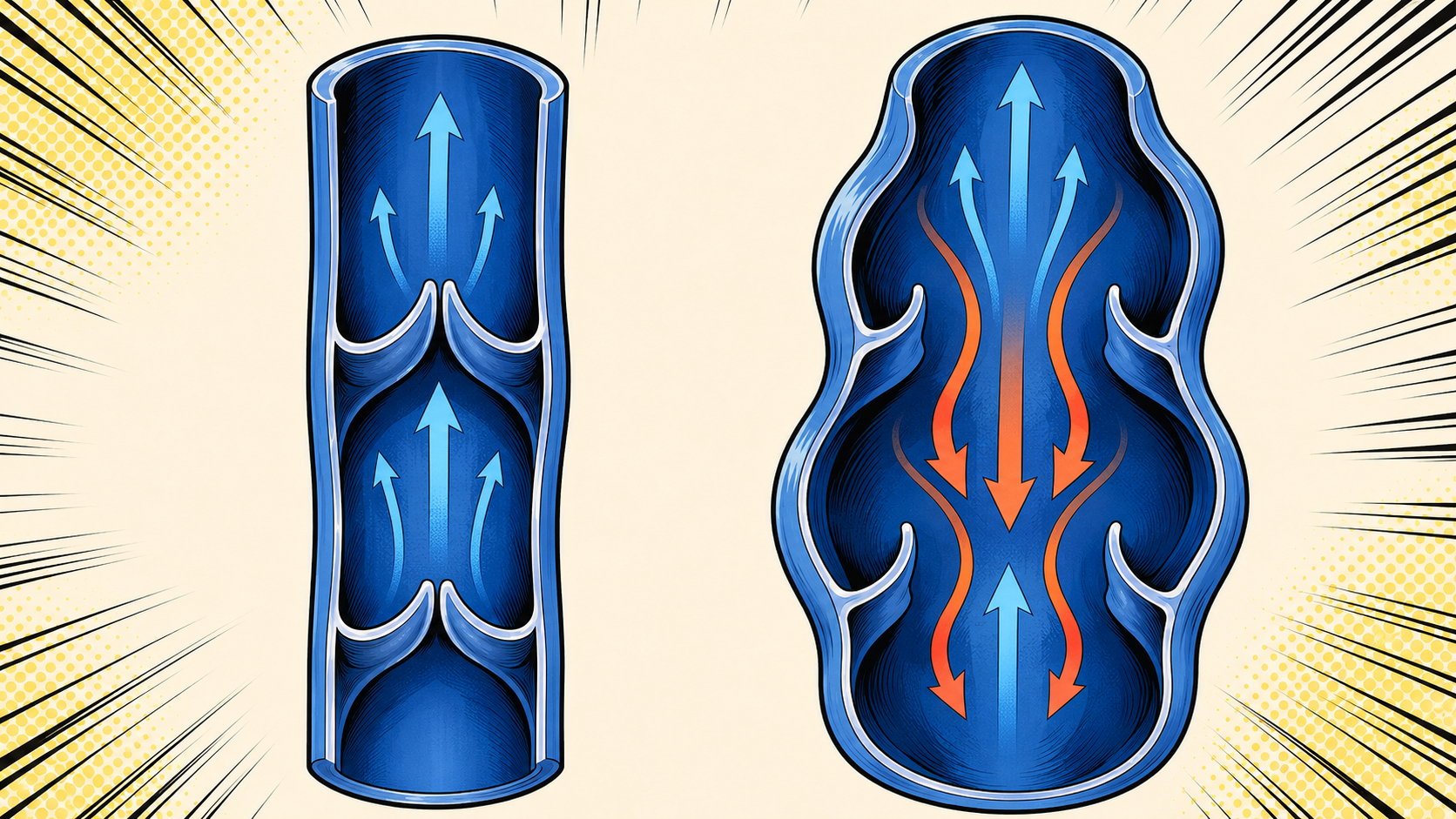
When a valve does not close properly, blood flows backward. Pressure builds and the vein may enlarge and twist.
- Valves act like one-way doors
- Poor closure allows backward flow, called reflux
- Ultrasound is used to locate reflux
How healthy valves work
- Walking activates the calf-muscle pump and pushes blood upward.
- Valves open to let blood pass, then close to prevent backward flow.
What happens when a valve leaks?
- Blood repeatedly flows backward and increases pressure.
- Superficial veins gradually enlarge and twist.
- Heaviness, aching or swelling may worsen after standing.
Normal return and venous reflux
| Comparison | Normal return | Venous reflux |
|---|---|---|
| Valve | Closes properly | Does not close completely |
| Blood direction | Toward the heart | Partly flows downward |
| Pressure | More stable | Gradually increases |
| Result | Vein remains more normal | Varicose veins may develop |
Note: Appearance alone cannot show where reflux begins. Standing leg-vein ultrasound can clarify the cause.
References
- De Maeseneer MG, et al. ESVS 2022 Clinical Practice Guidelines. Eur J Vasc Endovasc Surg. 2022;63:184–267. View source
This article is for health education only and does not replace individual medical assessment. Seek urgent care for acute symptoms.
Dr LiangVascular
Begin with a careful assessment.
Symptoms, examination and ultrasound findings are considered before treatment options are discussed.
Book an Appointment