Clinical Education
- Increasing swelling limited to the access arm
- New prominent veins over the shoulder, upper chest or neck
- Difficult cannulation, higher venous pressure or longer bleeding after dialysis
Why does the arm swell?
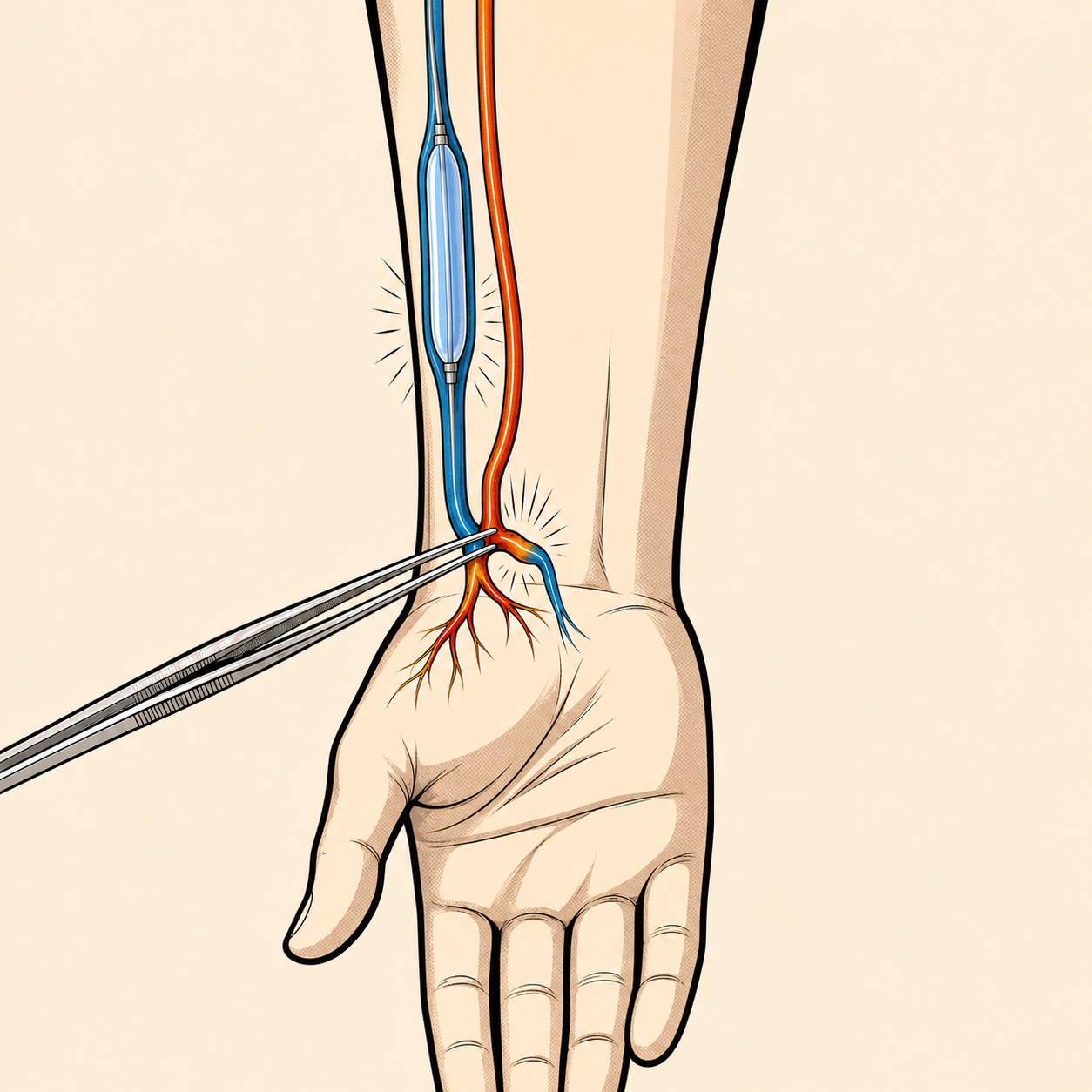
- A dialysis access sends increased blood flow into the arm veins. The blood then returns to the heart through deeper veins in the shoulder and chest. If this outflow pathway becomes narrowed, pressure can build up behind the narrowing and cause arm swelling.
- The risk may be higher in people who previously had a dialysis catheter, central venous catheter, pacemaker lead or PICC on the same side. However, central venous narrowing can also occur without these risk factors.
What changes should you notice?
- Increasing swelling limited to the access arm.
- Tight skin over the hand, forearm or upper arm.
- New prominent veins over the shoulder, upper chest or neck.
- Increasing difficulty with needle insertion.
- Higher venous pressure during dialysis.
- Bleeding that takes longer than usual to stop.
- An access that looks congested or feels difficult to compress.
- Swelling accompanied by pain, redness or warmth. These changes may also indicate infection or thrombosis and should not simply be observed until the next dialysis session.
Does every narrowing need vascular dilation?
- No. The KDOQI guideline identifies swelling of the access-side arm as a clinical indicator of a potentially significant lesion. However, a narrowing found on imaging alone should not automatically be treated when there are no symptoms and the access is functioning normally.
- I would assess the distribution of swelling together with the access examination, cannulation history, dialysis pressures and blood flow. Ultrasound can evaluate the access and arm veins first. Additional imaging may be required when a narrowing in the deeper chest veins is suspected.
- When the narrowing is confirmed to be causing symptoms or affecting dialysis, vascular dilation, a stent or another treatment may be considered according to its location and severity. The goal is not simply to improve the appearance of the image—it is to relieve symptoms and preserve a functional dialysis access.
What to notice when the access arm is swollen
| What you notice | What it may mean | Next step |
|---|---|---|
| Swelling limited to the access arm | Outflow pressure may be rising | Tell the dialysis team and arrange assessment |
| Prominent shoulder or chest veins | Collateral veins may be developing | Assess central venous outflow |
| Higher dialysis pressure or difficult cannulation | Access function may be affected | Arrange ultrasound or additional imaging |
| Rapid swelling, pain, redness, warmth or no thrill | Possible thrombosis or infection | Seek urgent care |
Note: Seek urgent medical care if the arm suddenly becomes severely swollen or painful, develops redness or warmth, the access thrill disappears, or breathing becomes difficult.
References
- Lok CE, Huber TS, Lee T, et al. KDOQI Clinical Practice Guideline for Vascular Access: 2019 Update. American Journal of Kidney Diseases. 2020;75(4 Suppl 2):S1–S164. View source
- Schmidli J, Widmer MK, Basile C, et al. Editor’s Choice—Vascular Access: 2018 Clinical Practice Guidelines of the European Society for Vascular Surgery. European Journal of Vascular and Endovascular Surgery. 2018;55(6):757–818. View source
- Echefu G, et al. Central vein stenosis in hemodialysis vascular access: clinical manifestations and contemporary management strategies. Frontiers in Nephrology. 2023;3:1280666. View source
This article provides general health education and does not replace individual medical assessment. Swelling may also be caused by infection, thrombosis, heart disease or impaired lymphatic drainage.
Dr LiangVascular
Begin with a careful assessment.
Symptoms, examination and ultrasound findings are considered before treatment options are discussed.
Book an Appointment