Clinical Education
However, a narrowing seen on ultrasound does not automatically mean that angioplasty is required. I consider the feel of the access, dialysis performance and ultrasound findings together before recommending treatment.
- The usual thrill feels weaker or different
- Needle insertion becomes difficult or requires repeated attempts
- The dialysis machine repeatedly shows pressure or blood-flow alarms
- Bleeding after needle removal takes noticeably longer to stop
- The access arm remains swollen or surface veins become more prominent
- Dialysis efficiency falls or the prescribed blood-flow rate cannot be achieved
What changes may suggest an access problem?
- The thrill becomes weaker, intermittent or different from usual.
- Needling becomes more difficult, or the machine repeatedly shows pressure or flow alarms.
- Bleeding after needle removal takes noticeably longer than usual.
- The access arm remains swollen or dialysis efficiency falls.
How is the access assessed?
- The access is examined by feeling its pulse and thrill and listening to the blood-flow sound.
- Ultrasound can assess the location of narrowing, blood flow and whether a clot is present.
- The inflow and outflow vessels are checked to determine whether the narrowing is affecting dialysis.
- The goal is not simply to identify a number on a scan, but to find the lesion causing the problem.
When may angioplasty be considered?
- Treatment may be considered when significant narrowing is confirmed together with reduced dialysis flow, difficult cannulation, prolonged bleeding or a change in the thrill.
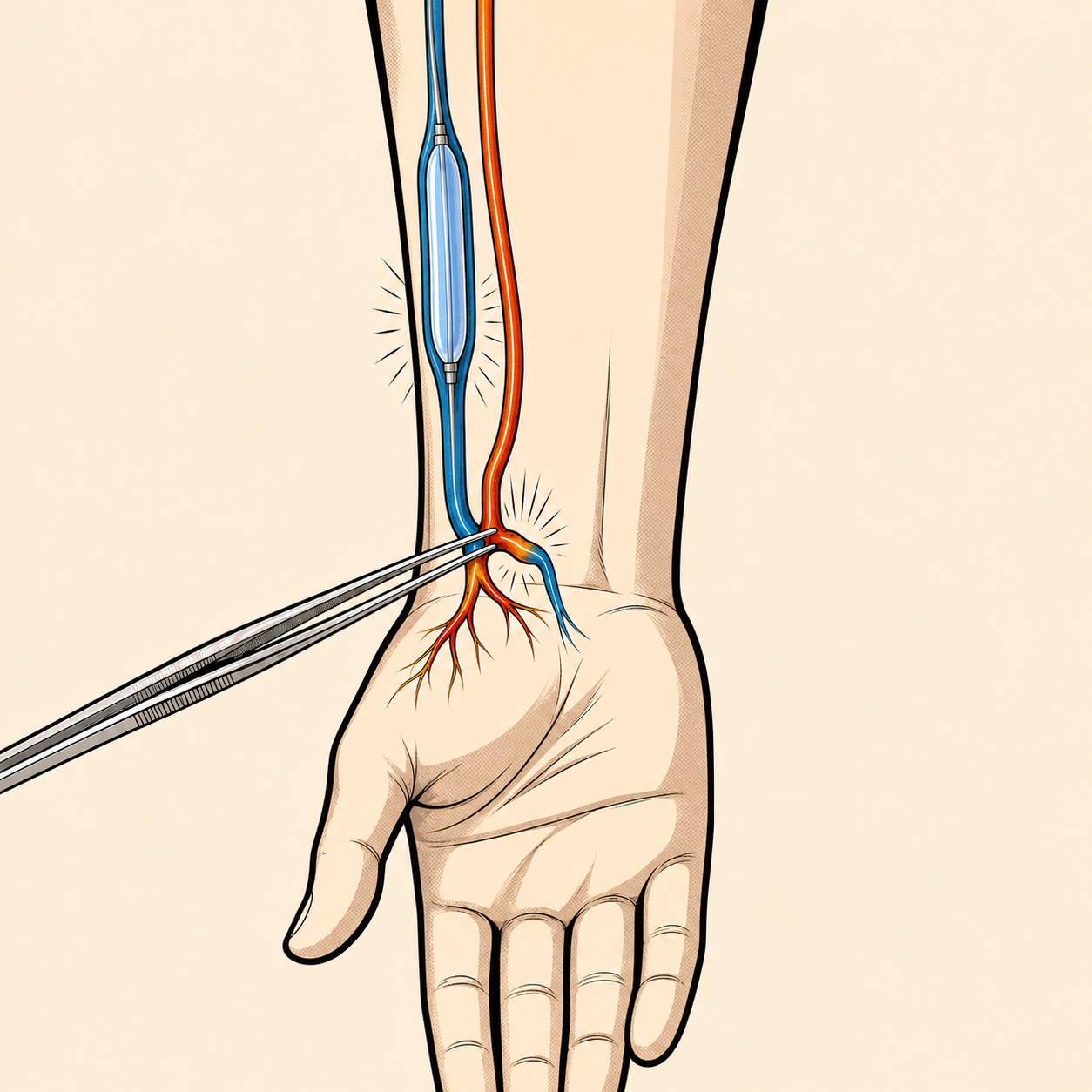
- A small catheter is placed inside the vessel, and a balloon is inflated to open the narrowed area and improve flow.
- The procedure is generally performed under local anaesthesia and usually does not require open surgery.
Can narrowing return after treatment?
- Angioplasty can improve blood flow, but it cannot guarantee that the vessel will never narrow again.
- Continued monitoring of the thrill and dialysis performance remains important.
- Repeated narrowing may require another treatment strategy or surgical reconstruction.
How is a narrowed access usually managed?
| Situation | Usual next step |
|---|---|
| Narrowing on imaging, but dialysis and the thrill remain stable | Continue clinical monitoring |
| Change in thrill, difficult needling or prolonged bleeding | Arrange ultrasound and vascular assessment |
| Confirmed stenosis affecting dialysis flow | Consider angioplasty |
| Complete disappearance of the thrill | Seek same-day assessment for possible thrombosis |
Note: Take a few seconds each day to feel the usual vibration of your dialysis access. If the thrill suddenly disappears, the arm rapidly becomes swollen, or bleeding cannot be controlled, do not wait until the next dialysis session. Contact the dialysis unit or arrange urgent vascular assessment.
References
- Lok CE, et al. KDOQI Clinical Practice Guideline for Vascular Access: 2019 Update. Am J Kidney Dis. 2020;75(4 Suppl 2):S1–S164. View source
- Schmidli J, et al. Vascular Access: 2018 Clinical Practice Guidelines of the European Society for Vascular Surgery. Eur J Vasc Endovasc Surg. 2018;55:757–818. View source
- Sidawy AN, et al. The Society for Vascular Surgery clinical practice guidelines for arteriovenous hemodialysis access. J Vasc Surg. 2008;48(5 Suppl):2S–25S. View source
This article is for health education only and does not replace individual medical assessment. Seek urgent care for acute symptoms.
Dr LiangVascular
Begin with a careful assessment.
Symptoms, examination and ultrasound findings are considered before treatment options are discussed.
Book an Appointment