Clinical Education
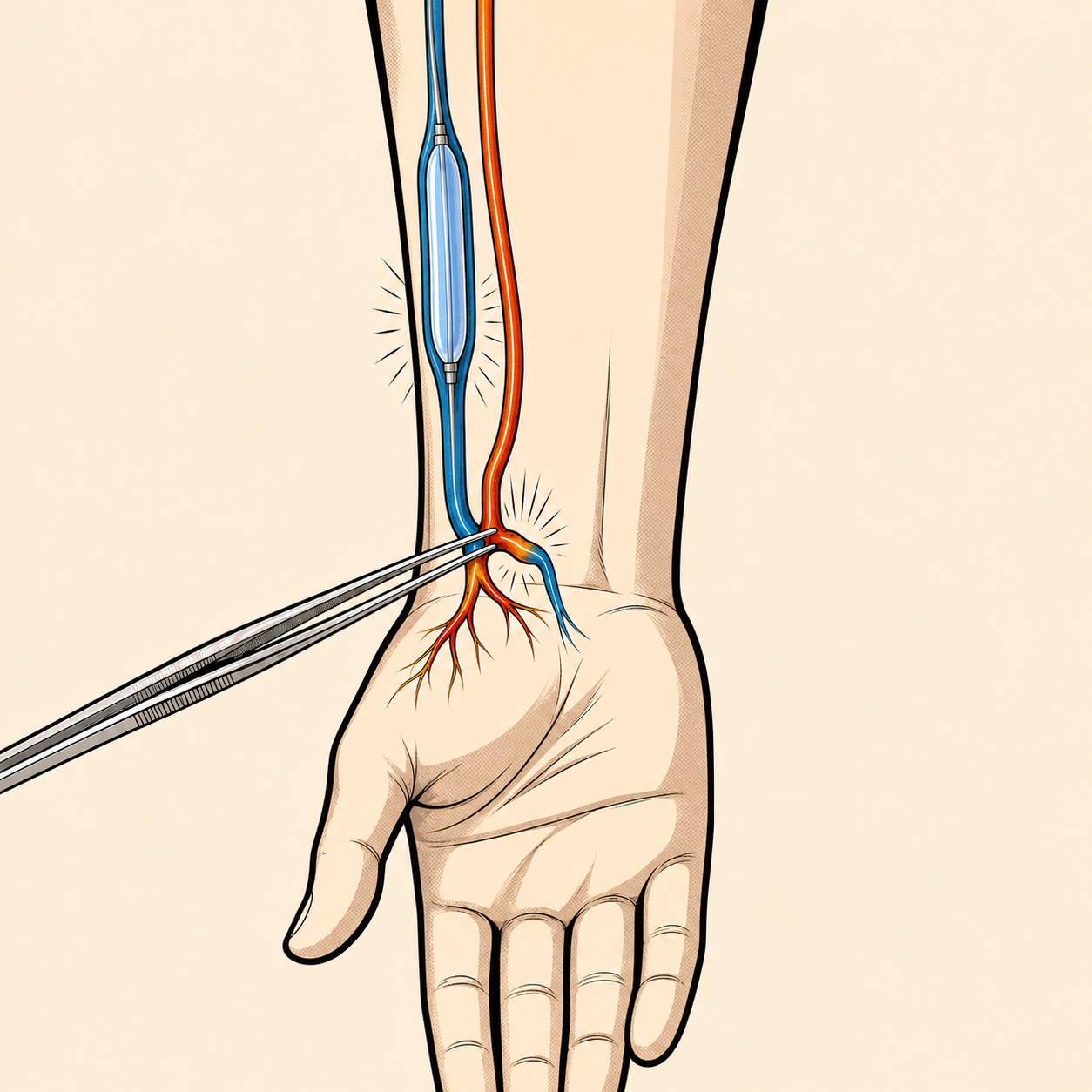
What matters is a clear change from your usual pattern, especially when it happens repeatedly. If the outflow vein becomes narrowed, pressure inside the access may rise and the needle site may take longer to stop bleeding.
- Bleeding repeatedly takes longer than usual to stop
- The access thrill becomes weaker or intermittent
- Dialysis flow falls, cannulation becomes difficult or the arm swells
What other changes should you notice?
- The access thrill becomes weaker or intermittent.
- The usual dialysis blood-flow rate cannot be reached, or venous pressure remains high.
- Needle insertion becomes difficult or clots are aspirated.
- The access arm swells, or dialysis efficiency falls without a clear reason.
More pressure is not always better
- Press directly over the needle site firmly enough to control bleeding while keeping the thrill detectable.
- Avoid repeatedly lifting your finger to check, and do not compress the entire access.
- If bleeding continues despite prolonged pressure, ask the dialysis staff for help.
Is vascular dilation always needed immediately?
- Not necessarily. Prolonged bleeding alone does not prove that the access is narrowed.
- The thrill, dialysis flow, cannulation, arm swelling and ultrasound findings should be assessed together.
- A narrowing that is not affecting dialysis may not need immediate treatment. Vascular dilation or another treatment is discussed when access function is affected.
What to notice when bleeding takes longer
| What you notice | What it may mean | Next step |
|---|---|---|
| One longer episode | Needle position, medication or blood pressure may contribute | Record and observe |
| Repeatedly longer than usual | Outflow pressure may be increasing | Tell the dialysis team |
| Weaker thrill or lower dialysis flow | Access function may be affected | Arrange assessment |
| Heavy uncontrolled bleeding or no thrill | Possible urgent access problem | Seek urgent care |
Note: Heavy bleeding that cannot be controlled, or complete loss of the access thrill, requires urgent medical attention. Do not wait until the next dialysis session.
References
- Lok CE, Huber TS, Lee T, et al. KDOQI Clinical Practice Guideline for Vascular Access: 2019 Update. American Journal of Kidney Diseases. 2020;75(4 Suppl 2):S1–S164. View source
- Schmidli J, Widmer MK, Basile C, et al. Vascular Access: 2018 Clinical Practice Guidelines of the European Society for Vascular Surgery. European Journal of Vascular and Endovascular Surgery. 2018;55(6):757–818. View source
- Lok CE, Huber TS, Orchanian-Cheff A, Rajan DK. Arteriovenous Access for Hemodialysis: A Review. JAMA. 2024;331(15):1307–1317. View source
This article is for health education only and does not replace individual medical assessment. Seek urgent care for acute symptoms.
Dr LiangVascular
Begin with a careful assessment.
Symptoms, examination and ultrasound findings are considered before treatment options are discussed.
Book an Appointment