中文版
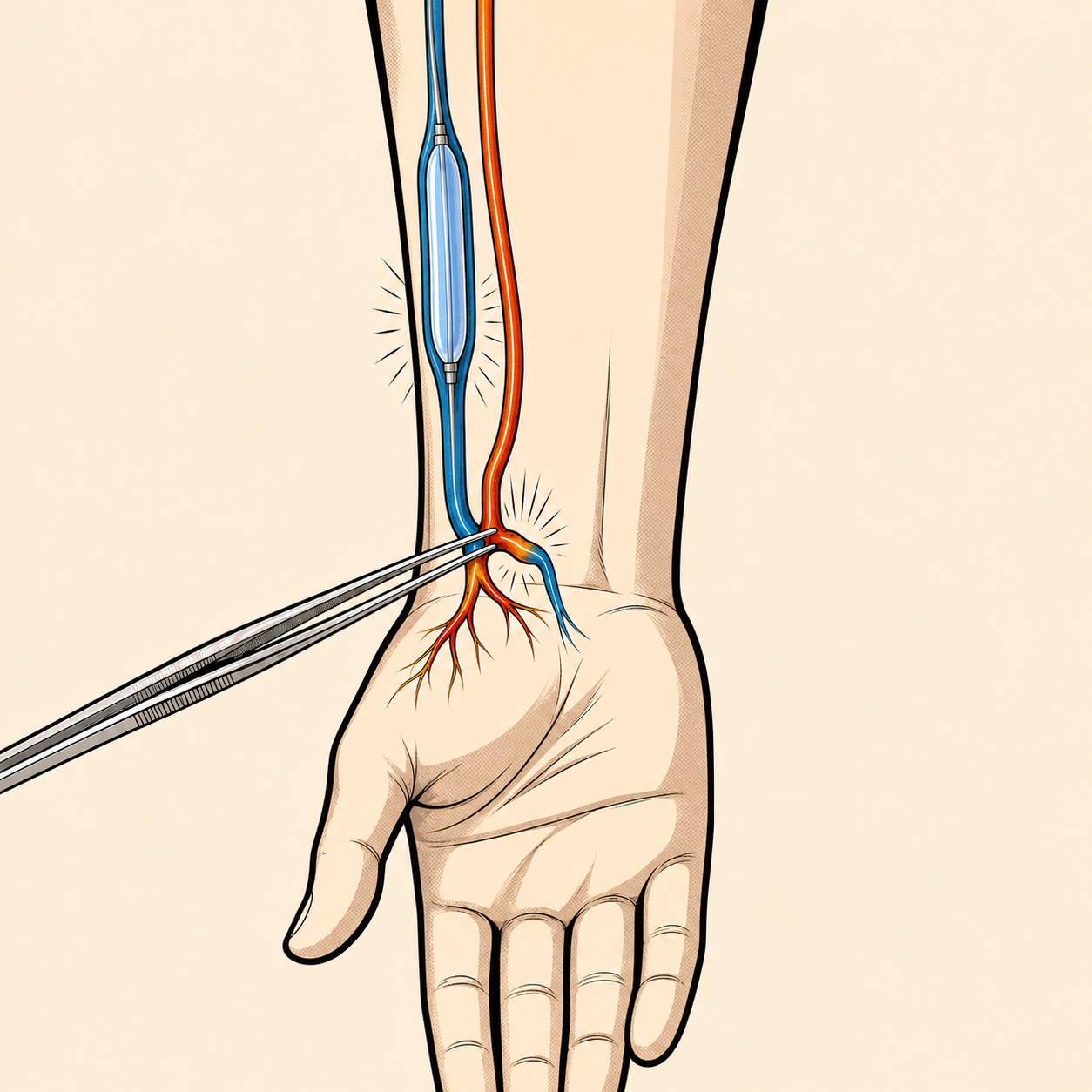
真正需要注意的是:止血時間和自己平常相比明顯延長,而且連續幾次洗腎都發生。當廔管回流的血管變窄,裡面的壓力可能增加,拔針後的針孔就可能需要更久才能止血。
- 止血時間連續幾次比平常明顯延長
- 廔管震顫變弱或斷斷續續
- 洗腎血流下降、下針困難或手臂腫脹
還有哪些變化需要注意?
- 廔管震顫比平常微弱、變得斷斷續續。
- 洗腎血流速度無法達到原本設定,或靜脈壓力持續升高。
- 下針突然變得困難,或容易抽到血塊。
- 廔管手臂明顯腫脹,或洗腎效率比平常差。
止血不是越用力越好
- 拔針後直接壓住針孔,力道以能止血、但仍摸得到廔管震顫為原則。
- 不要反覆掀開查看,也不要用力壓住整段廔管。
- 如果已經按壓很久仍持續出血,請直接請醫療人員協助。
一定要立刻做血管擴張嗎?
- 不一定。止血時間變久,不能單獨證明廔管已經變窄。
- 我會把震顫、洗腎血流、下針情況、手臂腫脹與超音波結果一起評估。
- 影像看到血管變窄,但沒有影響洗腎時,不一定需要立即治療;若已影響功能,才會進一步討論血管擴張或其他處理。
止血變久時,可以先看這些變化
| 觀察到的變化 | 可能代表什麼 | 下一步 |
|---|---|---|
| 偶爾一次止血較久 | 可能受下針、藥物或血壓影響 | 記錄並觀察 |
| 連續幾次都比平常久 | 可能有回流壓力增加 | 告訴透析單位 |
| 合併震顫變弱或洗腎血流下降 | 廔管功能可能受影響 | 安排完整評估 |
| 大量出血壓不住,或震顫消失 | 可能是緊急問題 | 立即就醫 |
提醒:如果廔管突然大量出血、壓不住,或震顫完全消失,請立即尋求醫療協助,不要等到下一次洗腎。
English
What matters is a clear change from your usual pattern, especially when it happens repeatedly. If the outflow vein becomes narrowed, pressure inside the access may rise and the needle site may take longer to stop bleeding.
- Bleeding repeatedly takes longer than usual to stop
- The access thrill becomes weaker or intermittent
- Dialysis flow falls, cannulation becomes difficult or the arm swells
What other changes should you notice?
- The access thrill becomes weaker or intermittent.
- The usual dialysis blood-flow rate cannot be reached, or venous pressure remains high.
- Needle insertion becomes difficult or clots are aspirated.
- The access arm swells, or dialysis efficiency falls without a clear reason.
More pressure is not always better
- Press directly over the needle site firmly enough to control bleeding while keeping the thrill detectable.
- Avoid repeatedly lifting your finger to check, and do not compress the entire access.
- If bleeding continues despite prolonged pressure, ask the dialysis staff for help.
Is vascular dilation always needed immediately?
- Not necessarily. Prolonged bleeding alone does not prove that the access is narrowed.
- The thrill, dialysis flow, cannulation, arm swelling and ultrasound findings should be assessed together.
- A narrowing that is not affecting dialysis may not need immediate treatment. Vascular dilation or another treatment is discussed when access function is affected.
What to notice when bleeding takes longer
| What you notice | What it may mean | Next step |
|---|---|---|
| One longer episode | Needle position, medication or blood pressure may contribute | Record and observe |
| Repeatedly longer than usual | Outflow pressure may be increasing | Tell the dialysis team |
| Weaker thrill or lower dialysis flow | Access function may be affected | Arrange assessment |
| Heavy uncontrolled bleeding or no thrill | Possible urgent access problem | Seek urgent care |
Note: Heavy bleeding that cannot be controlled, or complete loss of the access thrill, requires urgent medical attention. Do not wait until the next dialysis session.
References
- Lok CE, Huber TS, Lee T, et al. KDOQI Clinical Practice Guideline for Vascular Access: 2019 Update. American Journal of Kidney Diseases. 2020;75(4 Suppl 2):S1–S164. 查看來源
- Schmidli J, Widmer MK, Basile C, et al. Vascular Access: 2018 Clinical Practice Guidelines of the European Society for Vascular Surgery. European Journal of Vascular and Endovascular Surgery. 2018;55(6):757–818. 查看來源
- Lok CE, Huber TS, Orchanian-Cheff A, Rajan DK. Arteriovenous Access for Hemodialysis: A Review. JAMA. 2024;331(15):1307–1317. 查看來源
本文提供一般衛教,不取代個別診斷或治療。若有急性不舒服,請先就近就醫。
Dr LiangVascular
從完整評估開始
先整合症狀、理學檢查與超音波結果,再討論適合的治療選擇。
預約門診